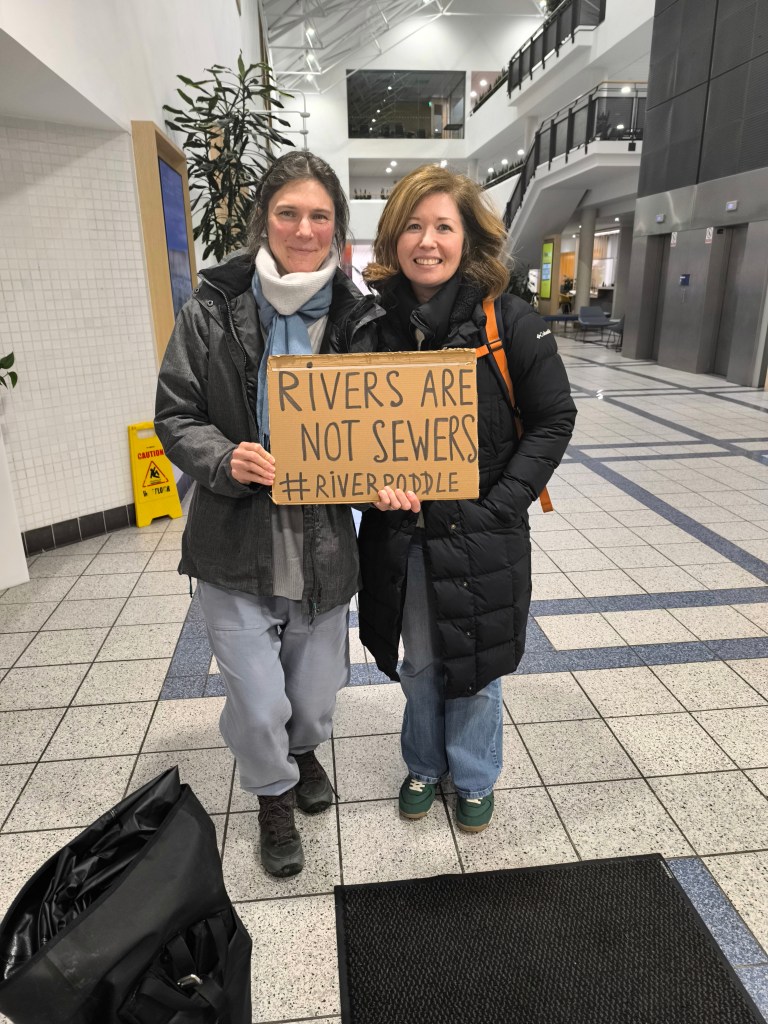
As part of her research on flooding, Kim joined me to do a bit of walking with the river Poddle between the Grand Canal and Ravensdale Park. If you’d like to go on a flood justice walking tour, get in touch anytime!
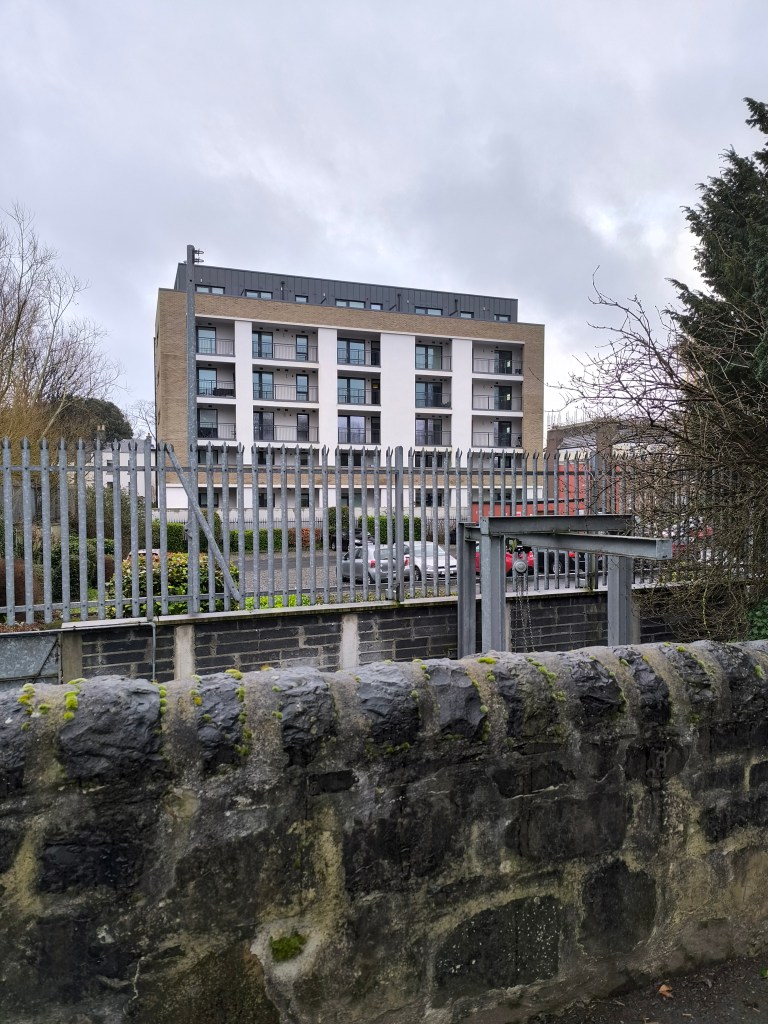
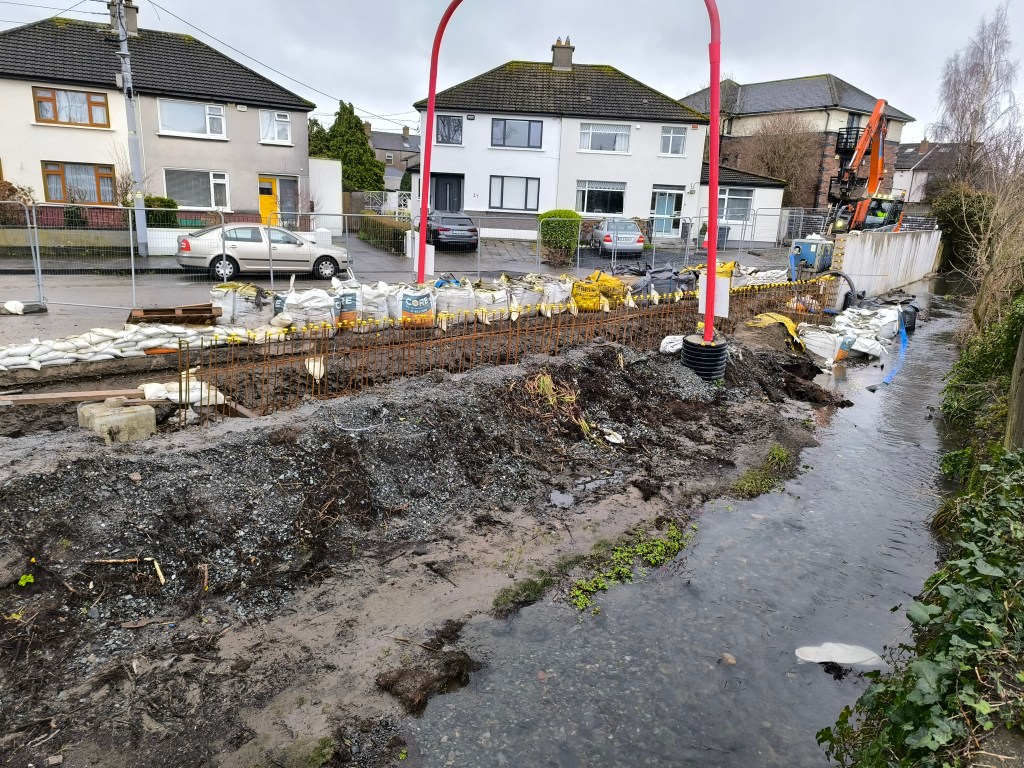
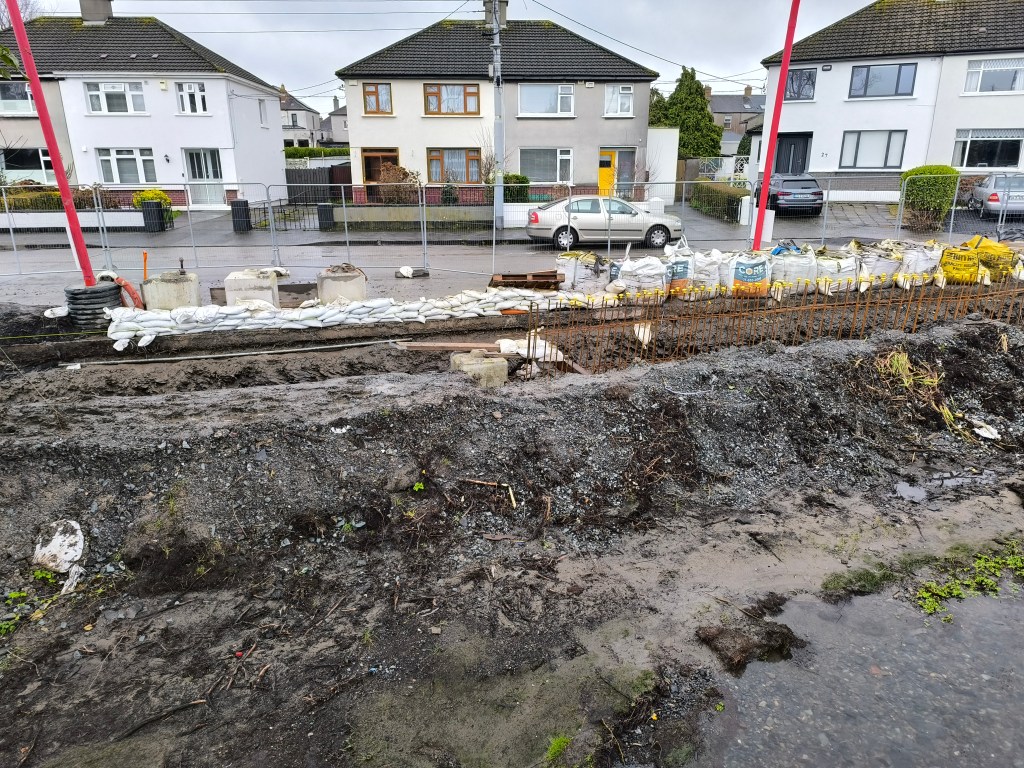
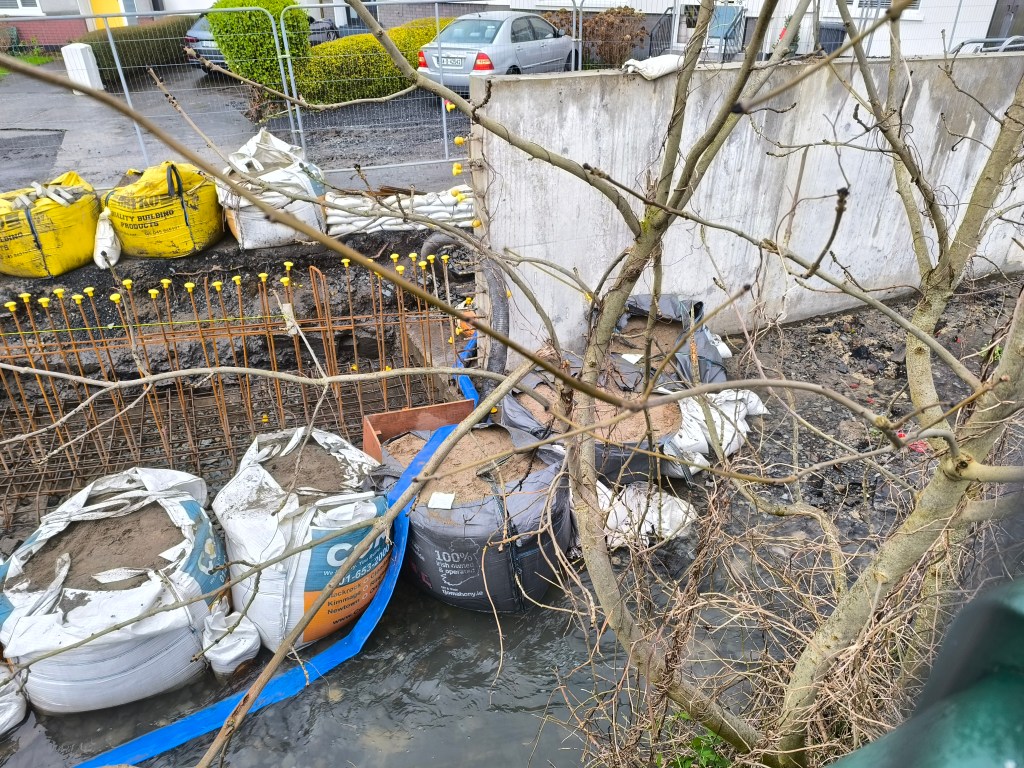
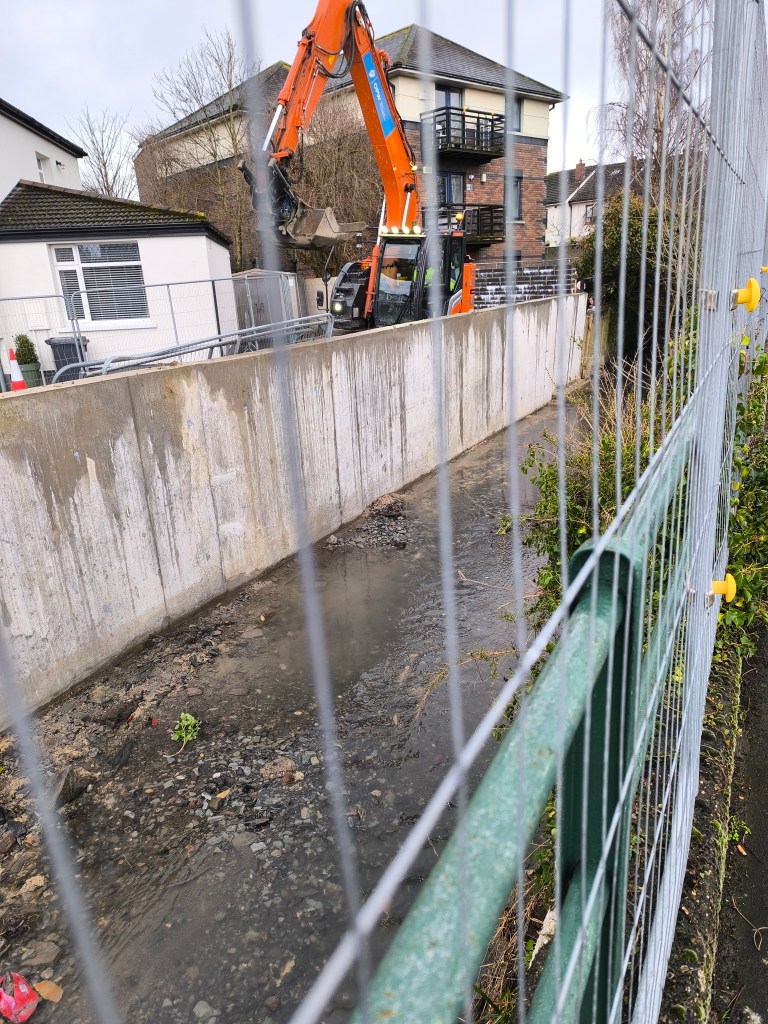
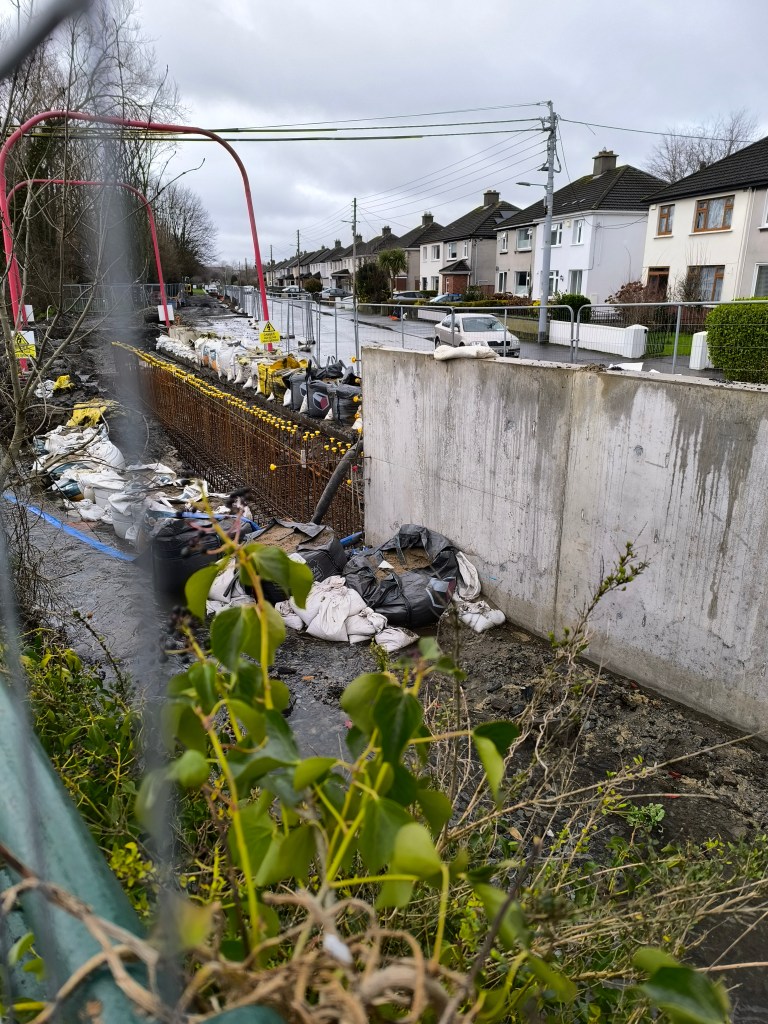
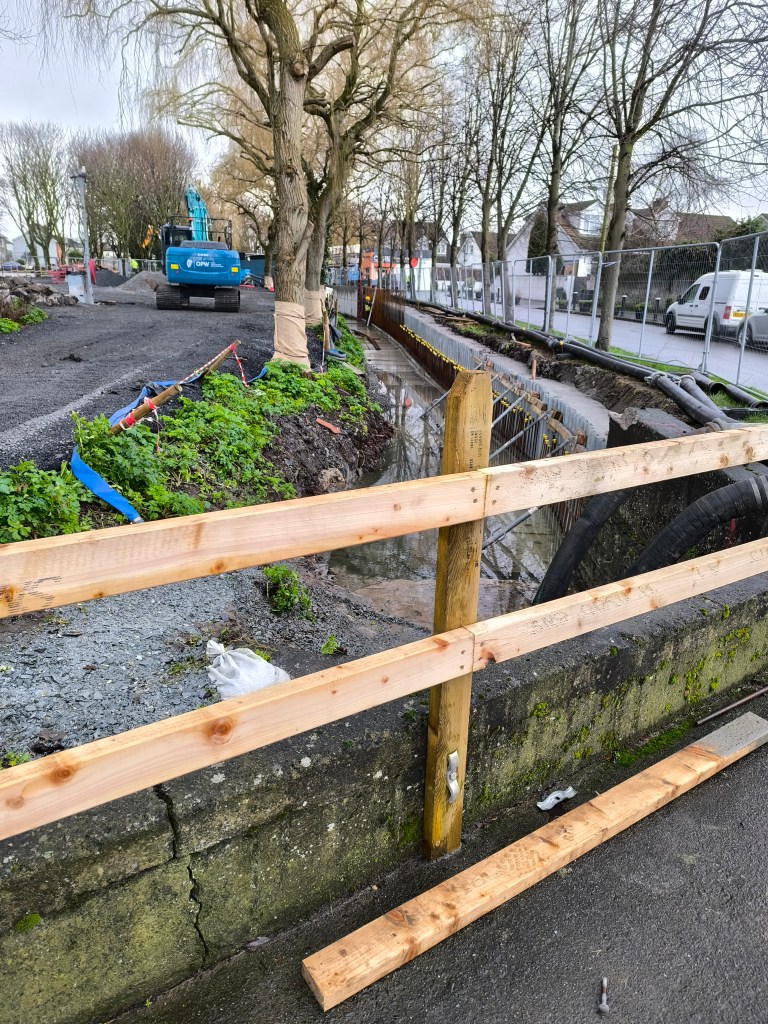
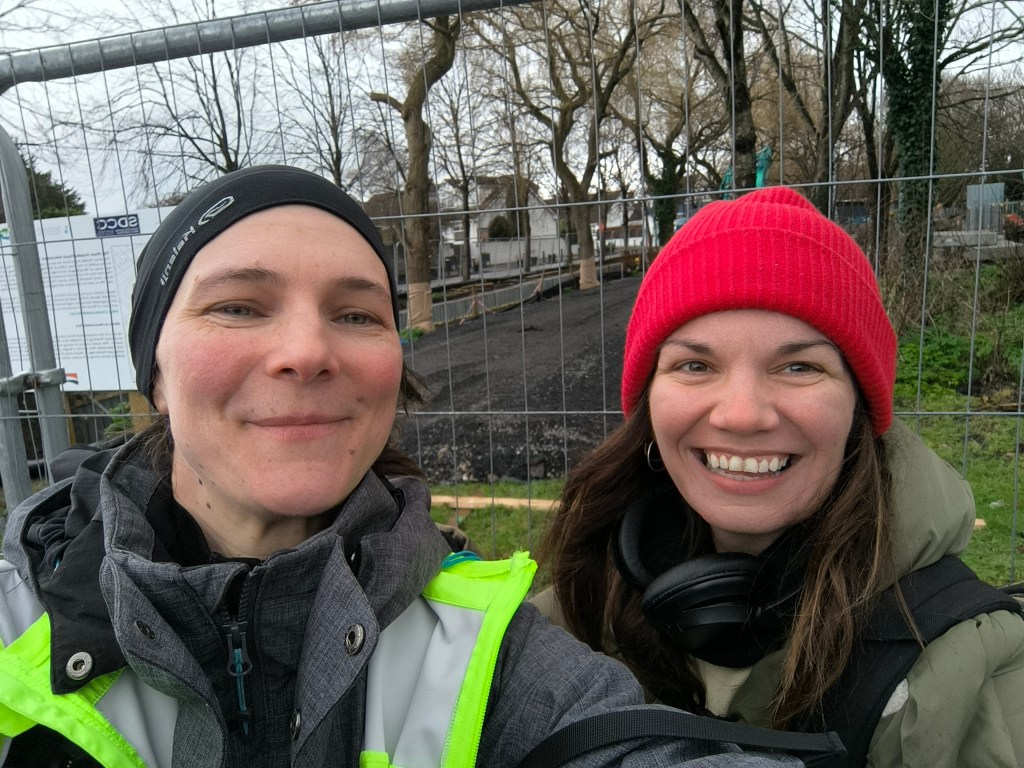
As part of her research on flooding, Kim joined me to do a bit of walking with the river Poddle between the Grand Canal and Ravensdale Park. If you’d like to go on a flood justice walking tour, get in touch anytime!
Are you planning to map a river in a personal or professional context? Then check out this detailed river mapping account. Thank you to the Livingmaps Network Team for welcoming the river Poddle in their online journal!
https://livingmaps.squarespace.com/from-mapping-to-walking-with
A previous post written in August 2025 outlined two issues concerning the management of the river Poddle by the local authority South Dublin County Council in the upstream part of the catchment. First, the underground piped part of the river is mapped as a “sewer” and/or at the wrong location in planning processes. It means that the environmental, ecological, flood risk impacts of developments on the river are not accounted for. Second, mapping the piped underground part of the river as a sewer or at the wrong location also means that its uncovering cannot be properly explored as prescribed in the local area plan.
The August 2025 post was shared with all Tallaght councillors. Councillor Jess Spear offered to start questioning the council about the different issues. 2 questions were submitted to the council (September & October 2025 committee meetings) and 1 motion was proposed (January 2026 committee meeting). Questions submitted to the council are responded to in writing whereas motions are responded to both in writing and in person.
1ST QUESTION (TALLAGHT AREA COMMITTEE MEETING, SEPTEMBER 2025)
“Can the Manager please give an update on the progress of uncovering/uplifting sections of the River Poddle and incorporating it into open space in Tallaght as per the Local Area Plan?” Please include any future plans.
1ST COUNCIL RESPONSE (TALLAGHT AREA COMMITTEE MEETING, SEPTEMBER 2025)
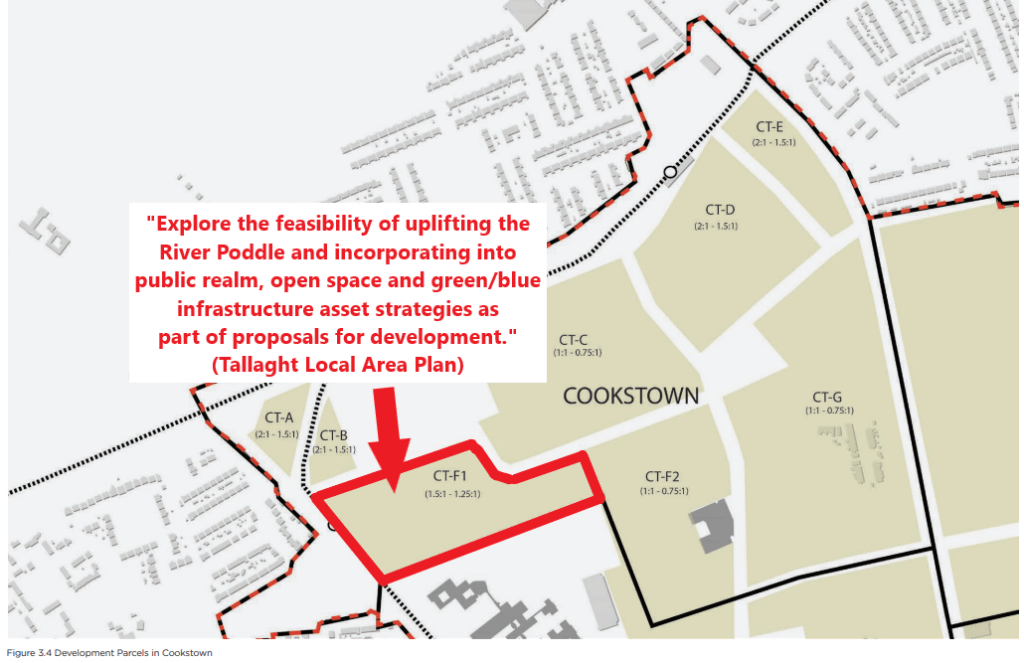
The Tallaght Town Centre Local Area Plan 2020 is a strategic framework for the sustainable development of Tallaght Town Centre. One of the many objectives of the plan is to “explore the feasibility of uplifting the River Poddle and incorporating into public realm, open space and green/blue infrastructure asset strategies as part of proposals for development”. This objective, TC15, is specific for the development of the area the plan defines as “the Centre”. More specific, the objective relates to a parcel of land adjacent to the northern and eastern boundary of the Work IQ Innovation Quarter, where the source of the River Poddle is located. As per the Local Area plan, the delivery of the objective will be subject to the planning and development of the site, which has not occurred. Any proposed development of the site will be considered in accordance with the objective of the Local Area Plan.
It should be noted the remaining areas of the River Poddle, within the Tallaght area, predominantly flows through open channel and form part of the key amenity value to the council parklands of Bancroft and Tymon Parks.
COMMENT RESPONSE 1
The council response is inaccurate. The development of the land parcel where the uncovering of the river Poddle must be explored has started (SD23A/0237). The river uncovering objective does not relate to a land parcel adjacent to the Work IQ Innovation Quarter. The source of the river Poddle is not located on a land parcel adjacent to the Work IQ Innovation Quarter. Information concerning lower parts of the catchment (Bancroft and Tymon Parks) is irrelevant.
2ND QUESTION (TALLAGHT AREA COMMITTEE MEETING, OCTOBER 2025)
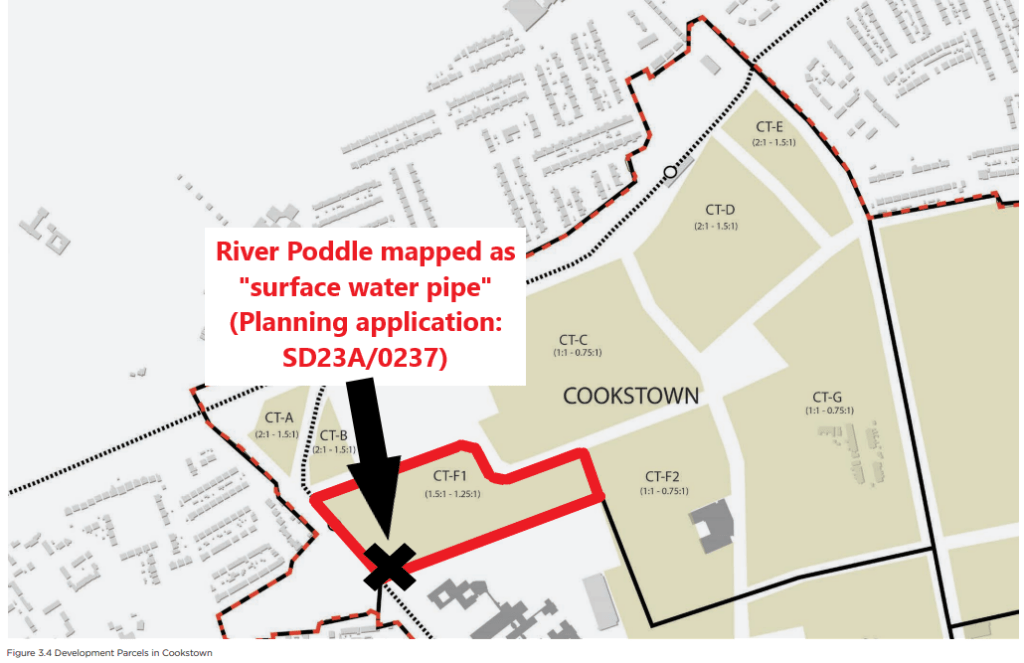
“What measures are to be taken as a matter of urgency to ensure that the development (planning application SD23A/0237) complies with the local area plan objectives for CTF1? I refer to your answer to my question on the uncovering of the River Poddle in Tallaght – ITEM ID: 88220. In the Local Area Plan, areas CTF1 and CTF2 are targeted for exploring the uncovering of the River Poddle. However, a new development has been granted planning permission in CTF1 on the basis of the River Poddle being referred to as a “surface water pipe/sewer/drain” (planning application SD23A/0237). It indicates that the river was not considered in the plans at all, let alone its uncovering?”
2ND COUNCIL RESPONSE (TALLAGHT AREA COMMITTEE MEETING, OCTOBER 2025)
The Tallaght Town Centre Local Area Plan 2020 is a strategic framework for the sustainable development of Tallaght Town Centre. One of the many objectives of the plan is to “explore the feasibility of uplifting the River Poddle and incorporating into public realm, open space and green/blue infrastructure asset strategies as part of proposals for development”. The objective TC15 is specific for the development of the area the plan defines as “the Centre”. More specific, the objective relates to a parcel of land adjacent to the northern and eastern boundary of the Work IQ Innovation Quarter, where the source of the River Poddle is located.
As per the Local Area Plan, the delivery of the objectives will be subject to the planning and development of sites and is reviewed on a case-by-case basis and where relevant. A number of factors are generally considered when proposing to uplift a section of river and as stated in the Tallaght Local Area Plan, they must be feasible. Some key considerations may relate to flood risk and potential risks and implications of uplift, ability to connect and link to high quality public open space, scale and quality of specific section of river and its proximity to rights of way and accesses, public transport and road networks. It should be noted that all proposed development sites that form planning applications are considered in accordance with the objectives of the Local Area Plan.
COMMENT RESPONSE 2
While the question is extremely specific, asking about a particular development and particular land parcels, the response remains extremely vague and general and does not address any of the question’s items. The inaccuracies found in the first response are repeated. Most concerning is the claim made by the council that they do consider flood risk and other risks whereas, as indicated in the question, the mentioned development did not account for the river as a river but as a sewer. The river was not taken into account in the development’s flood risk and appropriate assessments.
MOTION (TALLAGHT AREA COMMITTEE MEETING, JANUARY 2026)
“In line with the local area plan commitments to explore the uncovering of the River Poddle in Tallaght, this area committee calls on the Manager to bring immediate clarity on the following: describe the specifics of all exploratory assessments conducted so far and especially in relation to the first CTF1 development (planning application SD23A/0237); clarify how exploratory work is to be ensured now and in the future when the River Poddle is widely referred to as a “surface water pipe/sewer/drain” in developments’ planning applications (including in planning application SD23A/0237); clarify how uncovering is to be effectively explored if it is tied to individual planning applications and not applied to targeted areas as a whole?”
MOTION COUNCIL RESPONSE (TALLAGHT AREA COMMITTEE MEETING, JANUARY 2026)
The planning application SD23A/0237 was assessed by Natural Water Section of SDCC taking account of the following three documents – The Sustainable Drainage Explanatory Design and Evaluation Guide 2022, The County Development Plan 2022- 2028 and the Greater Dublin Regional Code of Practice For Drainage Works.
The examining of how the River Poddle can be opened up will be assessed on a case by case basis by Natural Water Section where planning developments are applied for adjacent to the River Poddle.
SDCC completed the Integrated Constructed Wetland (ICW) in Tymon Park last year to open up the Poddle and enhance the water quality and biodiversity.
COMMENT RESPONSE MOTION
Once again, the response does not address any of the motion’s items. Information concerning lower parts of the catchment (Tymon Park) is irrelevant as well as misleading. The ICW’s main aim was to address flood risk. The ICW is part of a wider flood scheme which was highly contested due to its foreseen harmful environmental and ecological impact. The flood scheme required high levels of hard engineering and tree removal throughout the catchment.
CONCLUDING WORDS
Accountability requires specificity. It requires calling a river a river and mapping a river where it actually flows. While the questions and motion did not succeed in bringing accountability (the ability to come forward and say ‘yes, what we did was wrong’, the ability to account for wrongdoings), it shed light on high levels of unaccountability. Unaccountability, in all its shapes and forms, is what we must keep fighting!
Laure de Tymowski (04/02/2026)
WHAT’S NOT TO LIKE ABOUT IT?
In 2016, Amazon acquired the site of the former Jacob’s factory in Tallaght, South Dublin, to build a data centre. Two years later, they applied to build a second data centre on the same site, next to the first one. This time, however, the local authority South Dublin County Council (SDCC)’s approval was granted on the condition that Amazon would facilitate access to their waste heat to power a local district heating scheme. “Waste heat” is generated by data centres through the process of cooling their processors and electrical equipment.
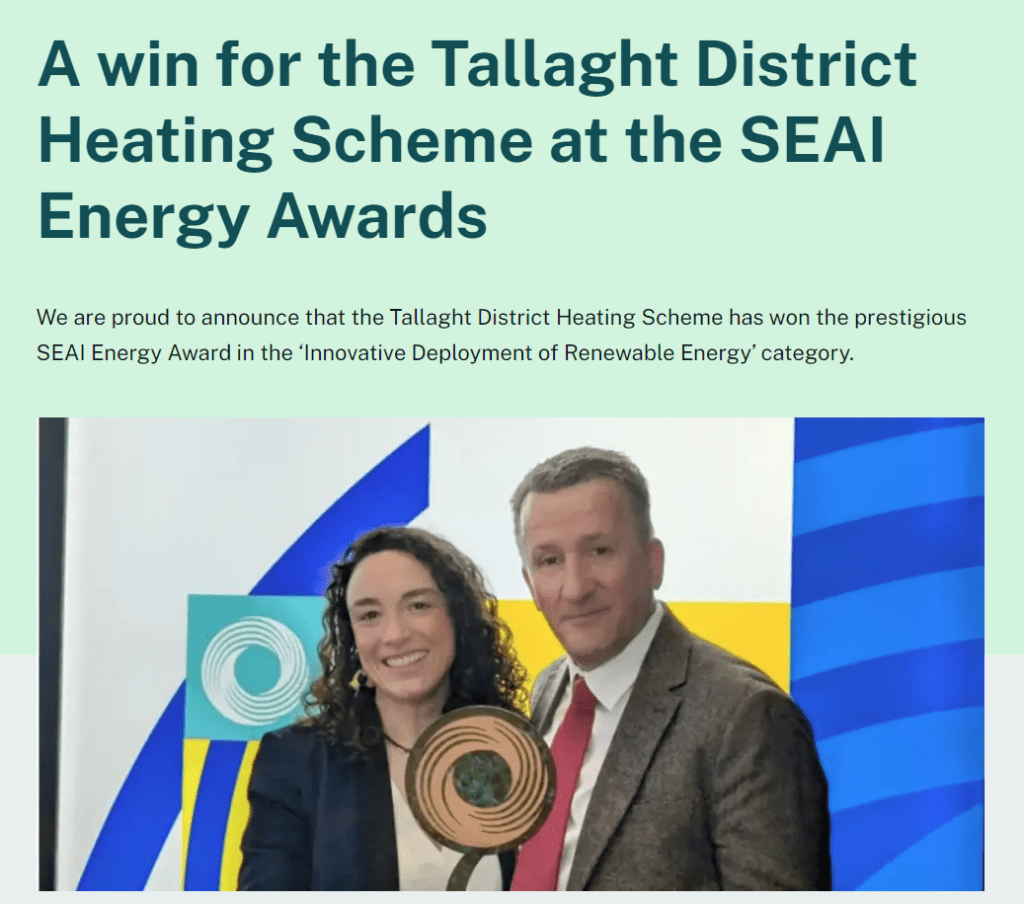
In 2023, the Tallaght District Heating Scheme (TDHS) was inaugurated in the presence of Minister for the Environment Eamon Ryan. The initial infrastructure, comprising the energy centre and some first connections, was built at a cost of €8 million, part state and part EU funded. The project was jointly developed by SDCC, Codema and Finnish energy company Fortum. The scheme itself is run by Heatworks, Ireland’s first not-for-profit energy utility fully owned by SDCC.
In receipt of multiple awards, the TDHS has been unanimously branded a success from both an environmental and social perspective. First, the scheme is said to have helped save a total of 1,100 tCO2 in the first year of its operation. Second, it is the first Irish not-for-profit energy utility, aiming to provide all connected buildings with affordable energy. What is more, in addition to its connection to local government and university buildings, it will power a forthcoming affordable housing scheme comprised of 133 cost-rental apartments. So, what’s not to like about it?
CLIMATE MITIGATION BENEFIT?
One of the claimed successes of the TDHS is its emission saving based on the use of waste heat by connected buildings instead of other energy sources. A focus on the TDHS emission saving, however, makes us overlook on which terms the scheme came to be implemented in the first place. Indeed, the TDHS was not built to offset the existing emissions of an existing data centre but only imposed as a condition for the construction of a new data centre! In other words, the real energy cost of the TDHS is the energy use and associated emissions of a whole new Amazon data centre! As observed by Hannah Daly, mitigation remains meaningless as long as it is accompanied by uncontrolled expansion. Ireland’s renewable energy generation is a case in point: how can it be expected to cater for ever-growing consumption while it cannot even cope with existing needs? Between 2020 and 2023, it only met 16% of the new electricity demand from data centres.
In contrast, in their district heating roadmap for South Dublin, Codema argue that (waste) heat sources should be considered separately from the actual (industrial) processes that originate them: these heat sources are a “by-product of a separate primary process”. From their perspective, the Amazon data centre waste heat is described as a “local”, “indigenous” energy source and the district heating it powers a “lower or zero carbon emissions” technology. Such a view, however, clearly obfuscates the highly contested energy supply chain which the waste heat is part of. In addition to its electricity consumption (21% in 2023) and carbon emissions (1,530,000tCO2 in 2023), the data centre industry puts communities across Ireland and beyond under increased pressure to bear the brunt of unsustainable energy infrastructure developments. In North Kerry, communities are faced with a plan by Shannon LNG to build a liquefied natural gas facility on the Shannon Estuary that would import fracked gas from the US. As for wind farms, they are too often erected on peatland, which may have devastating environmental effects as seen in Donegal in 2020. In this particular case, the wind farm developer had entered into an exclusive purchase agreement with Amazon.

ENERGY POVERTY BENEFIT?
In addition to its climate mitigation benefit, the TDHS is claimed to have the potential to address energy poverty. It implies that the ‘cheap’ energy obtained through the TDHS would benefit the most socially and economically marginalized residents of Tallaght. As of March 2025, the only confirmed residential connection to the TDHS was the forthcoming 133 cost-rental apartment complex being built by the local authority on public land in the centre of Tallaght. Allegedly, by providing 133 lower-middle-income households with affordable energy, the project could be seen as positively impacting energy poverty. The scope of the affordable housing scheme, however, must be assessed in context.
To begin with, the 133 cost-rental apartment scheme was not the only initially planned TDHS residential connection. In fact, for a number of years, those managing the TDHS project were relying on the expectation that a nearby private land plot would be redeveloped and connected to the district heating in its first development phase. The now abandoned large scale build-to-rent project was to include 1423 apartment units and 339 student units. The planned private development, already enormous in scale, was only one of many being discussed and planned in immediate proximity to the district heating infrastructure. In the current housing policy context, newly-built private rental apartments would only be accessible to higher-middle-income residents and therefore unlikely to include residents most vulnerable to energy poverty. What is more, nothing would prevent private landlords to capitalize on the green, affordable energy supply through increased rent and therefore cancel any benefit drawn from energy affordability. From such a scaled perspective, the energy poverty benefit of the 133 cost-rental apartments becomes far less significant.
Even more concerning, cost-rental apartments are aimed at the higher end of low-income households, explicitly excluding public/social housing and HAP tenants. But looking at Tallaght where the TDHS is being developed, what is the situation there? Tallaght and its surroundings host a high concentration of disadvantaged to very disadvantaged areas with a high proportion of public housing tenants: 17% overall and in some cases close to 80% in the most disadvantaged areas. In other words, it means that by design the cost-rental apartments cannot address the energy needs of the most socially and economically marginalized in its surroundings, no matter how many cost-rental apartments are built and connected to the TDHS. Furthermore, while cost-rental apartments are not accessible to public housing tenants, massive disinvestment in public housing in the last decades means that these tenants are too often left to live in decaying housing infrastructure that further compounds energy deprivation. The 2022 CSO data show that 73.3% of all local authority homes in Ireland have a BER rating of C, D or E.
Ironically, fieldwork conducted in 2022 revealed that, in a small public housing estate located only 250 meters from the TDHS energy centre, residents from the Traveller Community are left to face the worst energy access conditions. One of them, who lives in a caravan in wait of social housing, explains that their small gas heater must be left on at all times – “you have to leave it on because it’s so cold, you know” – and refilled every two weeks for €50. “It’s so cold, like, this is, this is gone up now 45, 55 a bottle, you know what I’m saying, this is very hard for me”. Another resident, this time living in one of the houses of the estate, makes the following statement: “It’s freezing, it’s freezing in this house and I am very, very cold in it”. Meanwhile, in Tallaght’s city centre, rough sleepers can be seen sheltering against the rain under the porches of public buildings connected to the TDHS.

A “PUBLICLY OWNED” ENERGY UTILITY ?
Heatworks, the company running the TDHS, is said to be “publicly owned”, but how does this claimed public ownership work in practice? Let’s look at three aspects of it: decision-making, access to information, and land ownership.
In terms of decision-making, the TDHS was subject to a Part 8 planning approval process. The process consists of the collection of public observations which are summarized in a report before being discussed by council staff and local elected representatives during a council meeting. As explained in the Codema district heating roadmap, the report “outlines whether or not it is proposed to proceed as originally planned or to proceed with a modified proposal”, which is another way to say that Part 8 projects may be altered but not refused. A resident who attended a local authority TDHS public meeting observed: “There was a public meeting once, but it was fait accompli, you know”. Even more telling are the district heating public engagement guidelines given by Codema to local authorities. They are very explicit about the necessity for local authorities to prioritize stakeholder engagement and they are very specific about how such prioritization should occur: “One way of prioritising stakeholders is to rank each one on the level of influence they could have on the project and also on the level of interest and enthusiasm they display for being involved”. Publicness sounds a lot more like exclusiveness here!
Obviously, access to decision-making is only meaningful if it is based on proper access to information. However, during the doctoral research at the origin of the present piece, access to information was found to be extremely poor. Three public officials involved in the TDHS project were contacted for interview but kept delaying it until they finally sent in a colleague in their place who had little idea about the TDHS. The manager of the site hosting the two Amazon data centres was sent an interview request by registered post but did not respond to it. Following such poor staff access, freedom of information requests were submitted but anything that was obtained through them came in heavily redacted. While piles of technical-jargon-oriented documents were produced, some of them publicly accessible, no clear, lay summary of the benefits versus downsides of the project for both local communities and Amazon was found. Amazon is only ever presented as a generous, disinterested benefactor making their waste heat and land available for free. But what about the water cooling produced through the heat exchange which benefits Amazon once the cooled water is returned to them? Why are they not charged for the cooling process as assumed by the company who peer-reviewed the TDHS business plan?
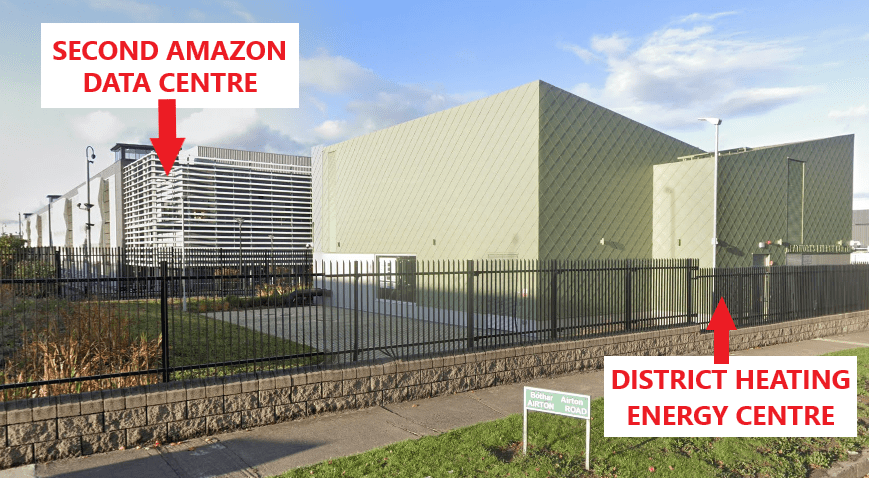
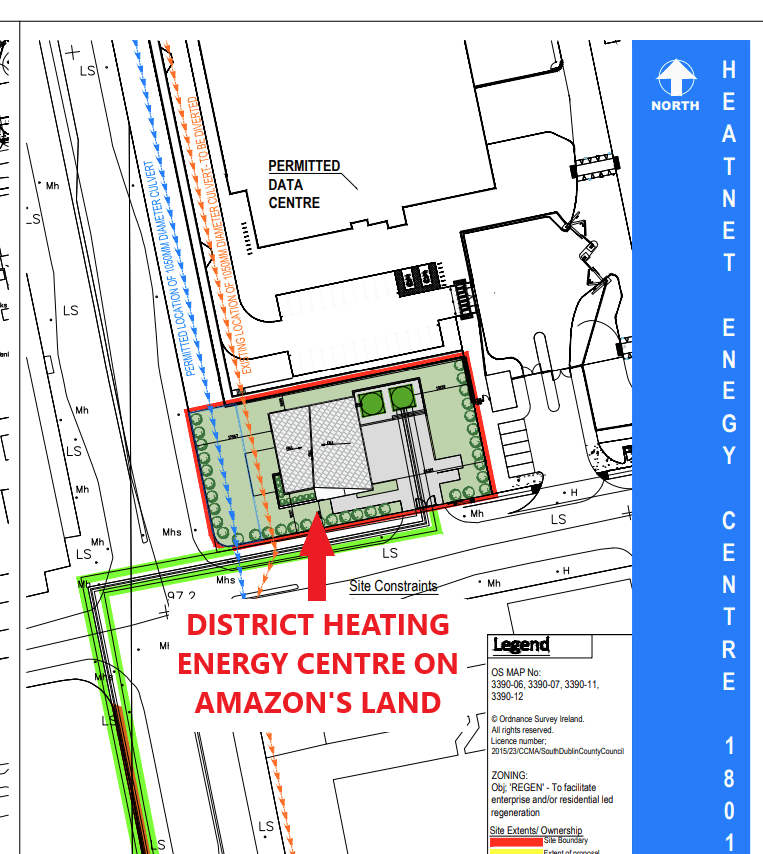
The ‘free Amazon land access’ leads us to the third point challenging the publicness of the TDHS. The district heating energy centre, the main infrastructure of the project housing the equipment to convert, store and distribute heat to the area, is actually located on Amazon’s land, beside their second data centre. In 2023, a freedom of information request was sent to SDCC to ask for a copy of the lease agreement. Surprisingly, on 17 August 2023, the council response was that, to date, the agreement hadn’t been finalized: “We anticipate the completion of this document in the coming weeks and if you wish to make contact in 2-3 months we can advise whether a redacted version of the executed document may be available, subject to third party approval.” This is highly surprising given that the district heating energy centre had been inaugurated a few months earlier in April 2023. In other words, it means that the publicly funded infrastructure was erected on private land without a finalized agreement. In February 2025, another freedom of information request was sent to obtain access to the finalized lease agreement, but access was refused: “This legal agreement is not publicly available as it contains information whose disclosure could prejudice the conduct or outcome of contractual or other negotiations of the person to whom the information relates.” In short, our “publicly owned” district heating infrastructure is on Amazon land and we have no means of accessing the terms of the lease. What would happen to it if the property is transferred to another owner?
NOT MENTIONED: THE JACOB’S SOCIAL CLUB
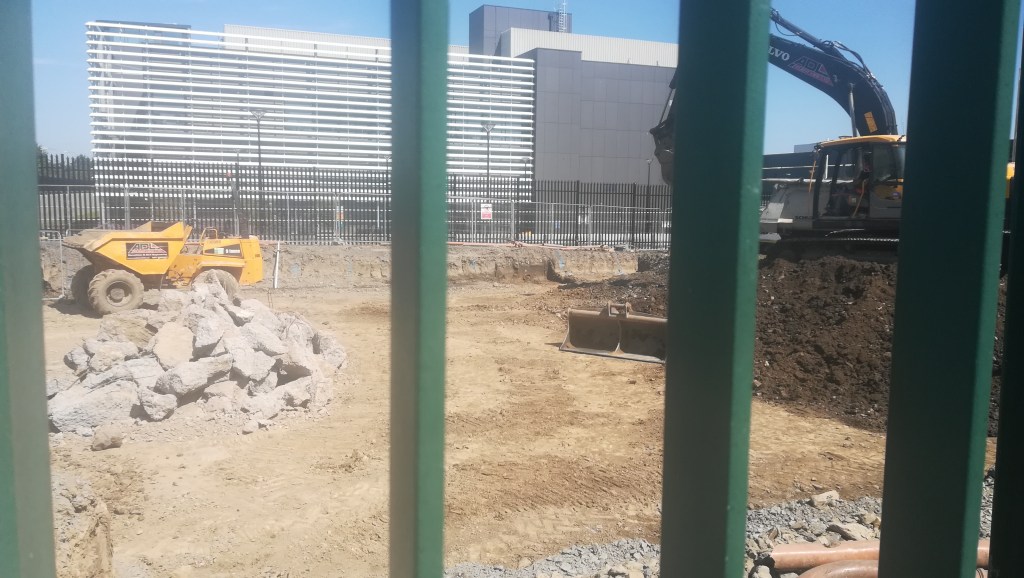
While much publicity is made of the benefits of the TDHS, the fact that the district heating energy centre was built on the demolished Jacob’s social club is barely if ever mentioned. The idea of building the social club on an unused plot of the Jacob factory’s site was first initiated by the factory’s employees in 1980. The employees would own the bricks and mortar and pay rent to Jacob’s for the land. “Life Members” invested in a brick each to cover the initial construction cost and thereafter were joined by other members for a small annual fee. Initially reserved for Jacob’s employees, the club subsequently opened to other local residents through word-of-mouth. Maintenance was funded through membership fee and drinks money, and energy bills were paid by Jacob’s. When the Jacob’s factory closed down in 2009, subsequent landowners maintained access to the social club and continued to pay the energy bills.
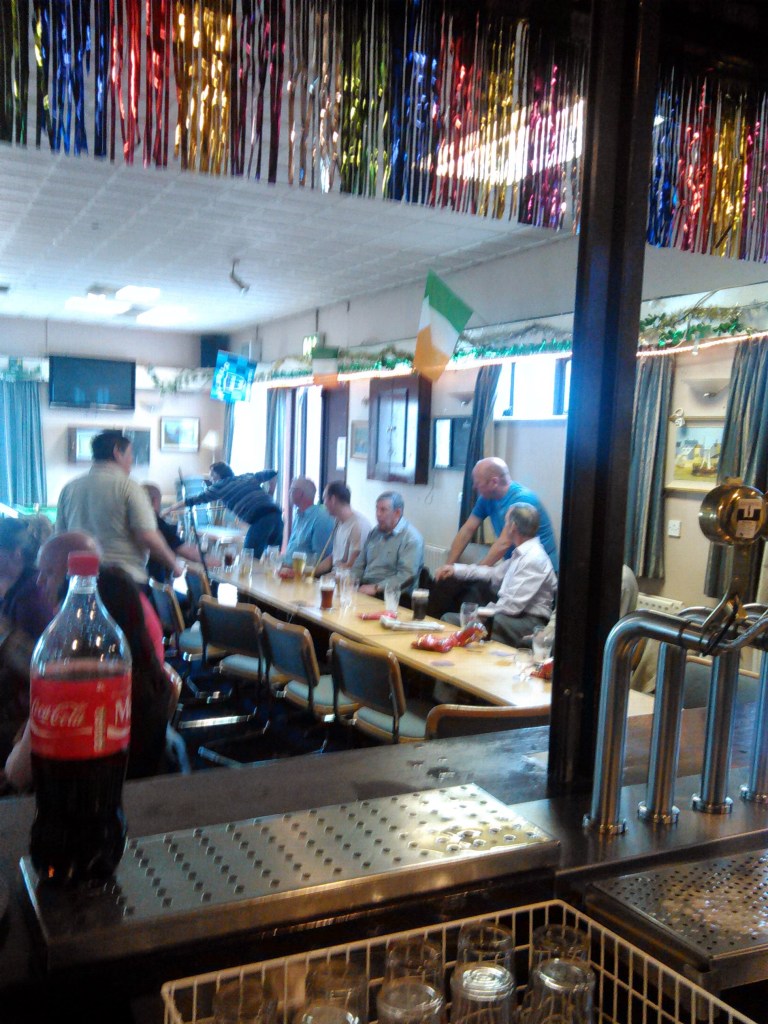
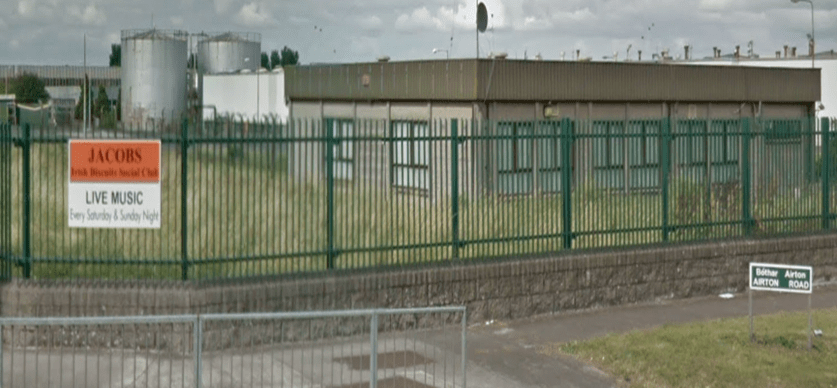
However, when Amazon acquired the site in 2015, the Club chairperson explains how things went very differently: “The Monday following the story in The Echo about Amazon taking over, I went to the club and found that the electricity and water was cut off. We can’t get a hold of anyone in Amazon. (…) The club is just getting left behind and bullied out of the building.” At the time of the takeover by Amazon, the social club was still very much in use: “Up to 50 old age pensioners used the site on a weekly basis and took part in art classes every Thursday, played pool on Sunday and met up for social nights every second Tuesday and Thursday.”
Once Amazon had closed the gates, no one was allowed in again: “we weren’t allowed back into it. Like the gate was locked, they, we originally had a lock on it, and they took the lock off and they changed the lock” (former Jacob’s employee). It means that no memory of the Club could be saved: “There was a mirror in the social club, they had a, what did they call it, a stage, now it was a very small stage, where the band would sit, behind the bands there was actually a mirror up on the wall, which had Jacob’s social club engraved on it and I would have loved if, before the factory or before it had been demolished, (…) we’ve got that (…), but you weren’t able to, they just locked the gates and no one else was able to go back into it.” (former Jacob’s employee)

While the detail of the talks between Amazon and the club members is not fully known, the outcome of the negotiations was widely publicized: Amazon paid the social club members a lump sum of €400,000 and members voted in favour of donating it to children’s charities. Talking to a former Jacob’s employee, however, it was confirmed that the committee had tried to obtain Amazon’s help in relocating the social club but that this aspect of the talks had not been successful. As observed by the former employee: “it did make them look good because it was public knowledge that Amazon donated for the social club rather than giving out money to the members, so it did make them look good”.
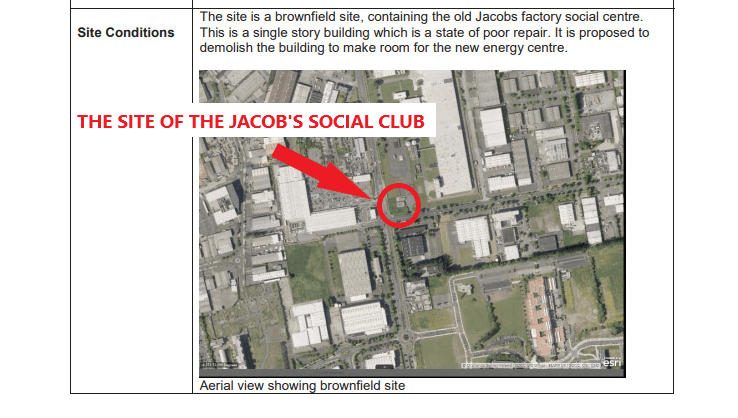
Subsequently, the social club was kept vacant and unused for another three years until its demolition in March 2019. The permission for its demolition was granted as part of the second Amazon data centre planning permission which was to power the district heating energy centre. In fact, the demolition of the social club was to make room for the new district heating energy centre itself. In 2019, SDCC applied to build the energy centre on the site of the demolished social club. This is how things are described in their Part 8 planning application: the site of the social club is called a “brownfield site” and the social club itself is depicted as “out of use” and in “a state of poor repair”. The only photograph of the social club in the report is an aerial one, further diminishing its significance and existence.
The commoning practices which had sustained the social club over the last decades, peacefully coexisting with different private owners prior to Amazon’s acquisition, were brutally severed. Through the demolition of the club, a whole working-class way of life and significant cultural heritage were erased. As put by a former Jacob’s employee talking about their late father, “My father’s life was Jacob’s. Pitch and putt, and the social club. (…) That was his life.”
NOT MENTIONED: THE RIVER PODDLE
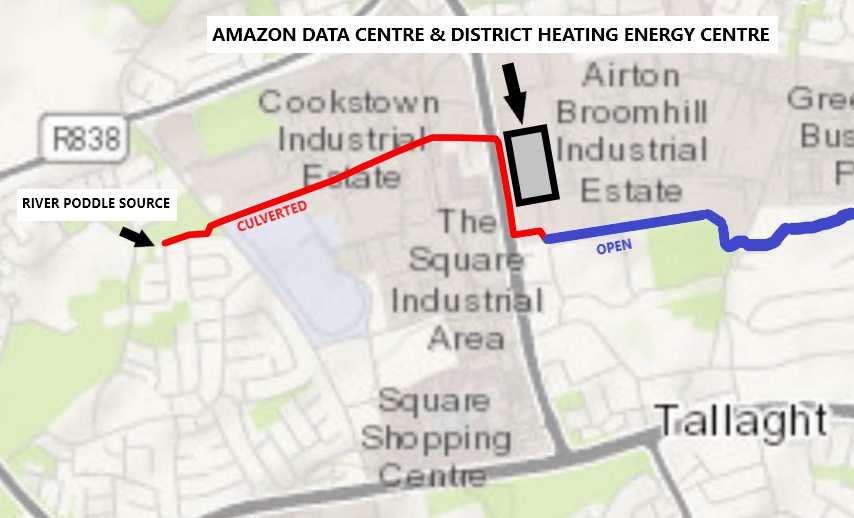
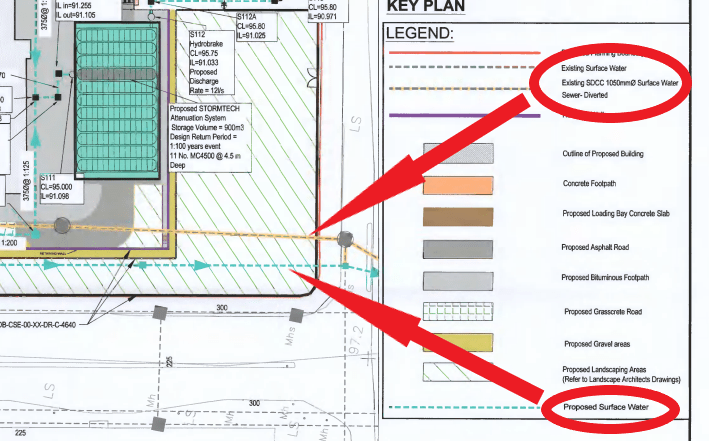
The Jacob’s social club was not the only thing to be disqualified in the process of developing the TDHS. In the same planning application allowing Amazon to build a second data centre and demolish the social club, they also received permission to divert a piped section of the river Poddle to make room for their second data centre. In the planning application, however, the river is not mentioned by its name but designated as a “1050 mmo surface water drain/sewer”. The dismissing of the river by Amazon’s consultants, fully sanctioned by the local authority, is part of a wider attempt to make the river disappear in this upstream part of the catchment. The practice is no doubt of benefit to the property developers who build on the lands surrounding the district heating facility: indeed, no river equals no need for river-oriented flood risk and environmental assessments. The dismissal of the river at this location is especially at odds with the local area plan commitments to explore its uncovering. And wasn’t the River Poddle one of the first sources of potable water in Dublin and which gave the city its name? Reducing the River to a drain is altogether discarding its ecological and cultural value.
NOT MENTIONED: LIFE ACROSS THE ROAD FROM TWO DATA CENTRES
Also forgotten in the TDHS development process and nowhere to be seen in its success story are the residents living close to the two Amazon data centres. Knocking at a few doors in proximity to the data centres and district heating energy centre in 2022 revealed some of the issues encountered by these residents. Two major issues mentioned during the door-knocking were water access and noise pollution. While water pressure in the area had been very poor for decades, some residents argued that the construction of the two data centres next to their homes made it worse. As one resident put it at the time, “Our toilets won’t fill because of the Amazon, across the road. (…) It’s when Amazon is on, our toilets won’t fill.” Isn’t it incredible that Irish Water worked tirelessly to provide Amazon with all their water needs while residents had been left dealing with poor water infrastructure for decades! As explained by a local tenant, low water pressure means that their washing machine sometimes stops halfway through its cycle and that they have to add water to it manually from a nearby water tank to restart it. Another issue mentioned during door knocking was that of noise coming from the data centres. “You have noise in your house, you know, they can’t open the window either. In the summer you have to leave your windows to keep the sound out, you know, you understand, and they say it’s alright, it’s wonderful.”
WHAT’S TO LIKE ABOUT IT?
This short piece shows that any energy transition success story should be assessed with much caution. Centrally and above all, we must ask: who is telling the story? In the case of the TDHS, most of its success accounts come from public representatives as well as from journalists who most likely have never set foot in the communities bearing the brunt of our data centre driven energy transition. And if they did, have they meaningfully engaged with those communities? Data presented in the piece only offer a short glimpse into the type of classist, racist, gendered inequalities ignored and reinforced through the TDHS. However, they already bring ample evidence that everything that has been done to complete the TDHS goes against the most basic principles of a just energy transition: equity and inclusiveness. Thus, we must ask, what’s to like about it?
Laure de Tymowski (01/11/2025)
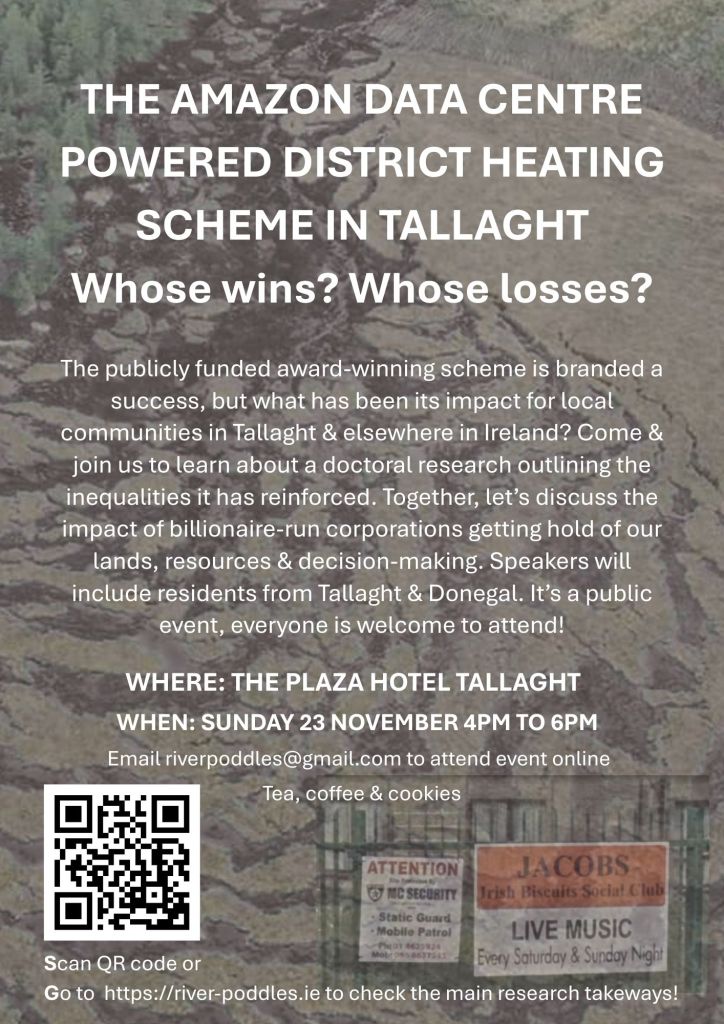
Acknowledgments: Huge thanks to All who have contributed to the doctoral research at the origin of the present piece and to All who have helped improve the piece content before publication. Huge thanks also to those helping with the organization of the forthcoming public gathering on 23 November 2025. See you there!
Part of the data presented in this post were quoted in Gerry McGovern’s piece: https://www.hotpress.com/opinion/ai-data-centres-will-eat-you-alive-23123736
According to the local authority, the river Poddle flood alleviation scheme focuses on “nature-based solutions and biodiversity“. We must keep asking them what they mean by this!
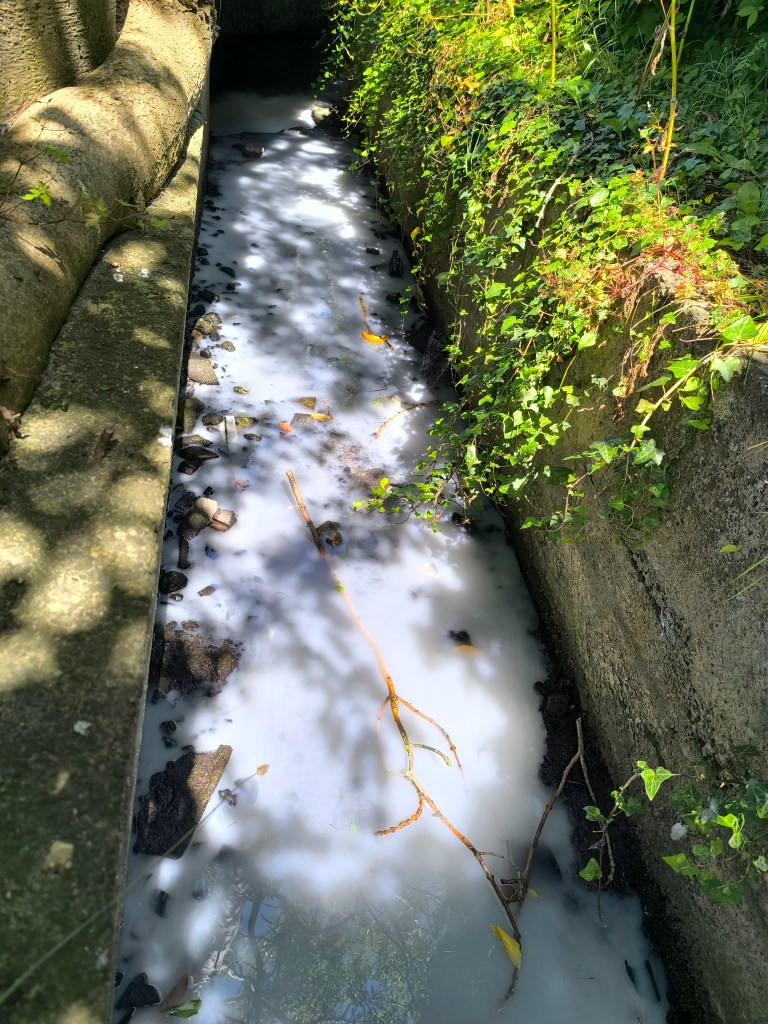
On 3rd July 2025, the Irish Independent published an article on local concerns about the river Poddle pollution affecting swans in Tymon Park, South Dublin. The concerns were first discussed during a local area committee in June 2025. During the meeting, a local councillor proposed a motion requesting South Dublin County Council to take immediate action to address a recurring localized pollution issue in Tymon Park North. Beyond the local incident, pollution events are widespread and ongoing throughout the river Poddle catchment. In response to the motion, the local authority produced a written report. In this short post, an assessment of the article, report and recorded committee discussions is used as a practical example to illustrate how to go about critical reading.
PROBLEM FRAMING: WHAT IS SAID ABOUT IT
This might seem obvious but is worth highlighting again and again: not everything that is said in newspapers, local authority reports or council meetings should be taken for granted. Room must always be kept for some critical thinking. In this post, we focus on one aspect of critical thinking, which is concerned with problem framing. When you hear something or read something that is about framing a problem and its solution, you always have to ask: how is the problem presented to me? How are causes described and responsibility distributed? And, most importantly: what is missing and how could have the problem been presented and described differently?
In the case we are looking at, the river Poddle pollution problem is always framed in terms of either industrial pollution (but remains marginal and industrial actors are never identified) or, much more systematically, residents’ misconduct. It’s mostly about some uninformed or malicious residents out there misconnecting their pipe or throwing some leftover paint down the drain. In short, the problem is framed in ways that make us, residents of the catchment, the main cause of the problem.
Another significant aspect of the pollution problem framing in the assessed material is that the problem is presented as very difficult to address: because the framing focuses on these localized, individualized, flash pollution incidents, the pollution issue is described at length as very difficult to resolve. As observed by the local authority representative attending the committee, “proving where that pollution is coming from can be quite a challenge in terms of the water network and how quickly it can wash through”.
In short, the river Poddle pollution problem is framed so as to make us think that:
1) residents of the catchment along with some businesses are the main pollution culprits.
2) the issue is very difficult to resolve.
PROBLEM FRAMING: WHAT IS NOT SAID ABOUT IT
Framing exclusively a problem in terms of individual behaviour and individual responsibility is a well-known strategy aiming at deflecting attention from institutional responsibility and system failures. Whenever you are told that individuals are the problem, your critical reading red light should go on. In the river Poddle pollution case, the responsibility of the local authority and of other state actors is never explicitly engaged, so what is left aside in their problem framing narrative? Based on years of research in the river Poddle catchment, three overlooked problem framing angles are briefly described in what follows.
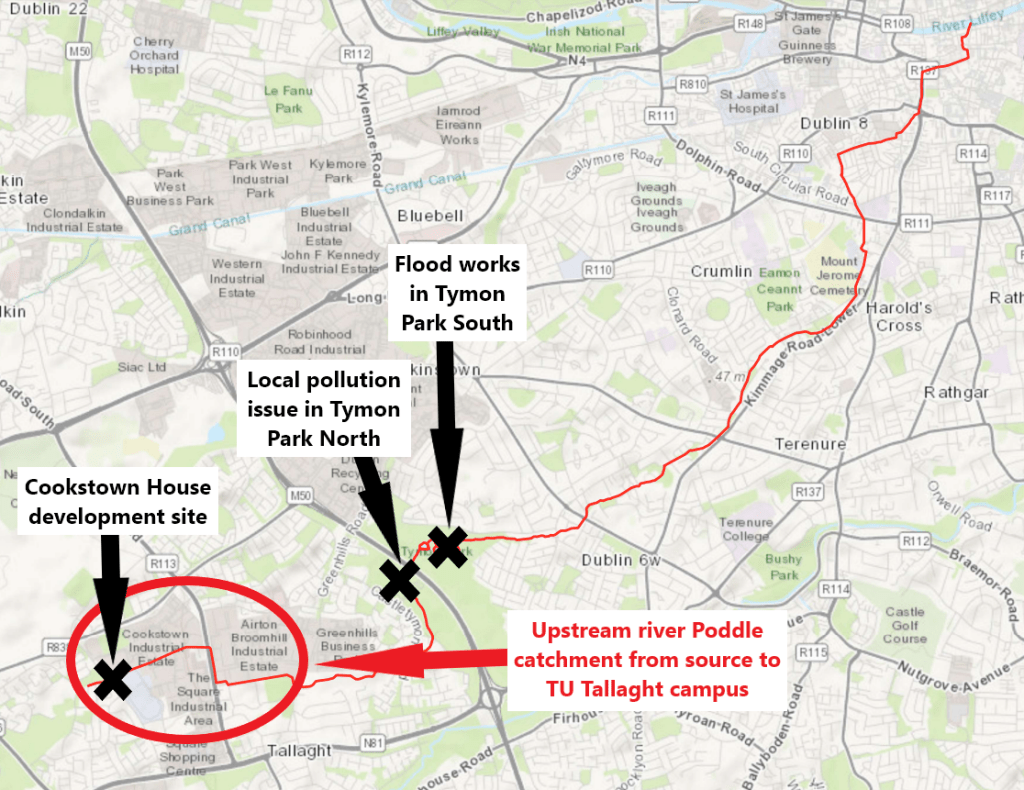
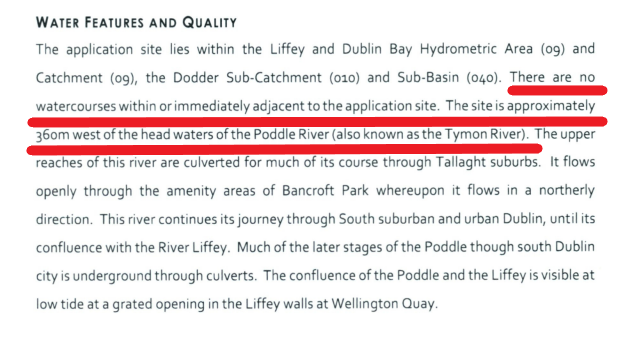
To begin with, the local authority and state agencies such as Irish Water have constantly mapped the upstream culvert of the river Poddle from its source down to the TU Tallaght campus as a “gravity surface water sewer” or similar, not as a river. What is more, they have constantly allowed developers to do the same (see Cookstown House development examples below and more examples in a previous post). Altogether, it means that, in this part of the catchment, the river is systematically overlooked in environmental assessments (and flood risk assessments!) and, for this reason, is also highly unlikely to be properly considered during development works. Returning to the 2024-approved Cookstown House development example, the river Poddle is wrongly mapped 360m away from the development site in the appropriate assessment (see appropriate assessment extract below) and not even mentioned once in the flood risk assessment.
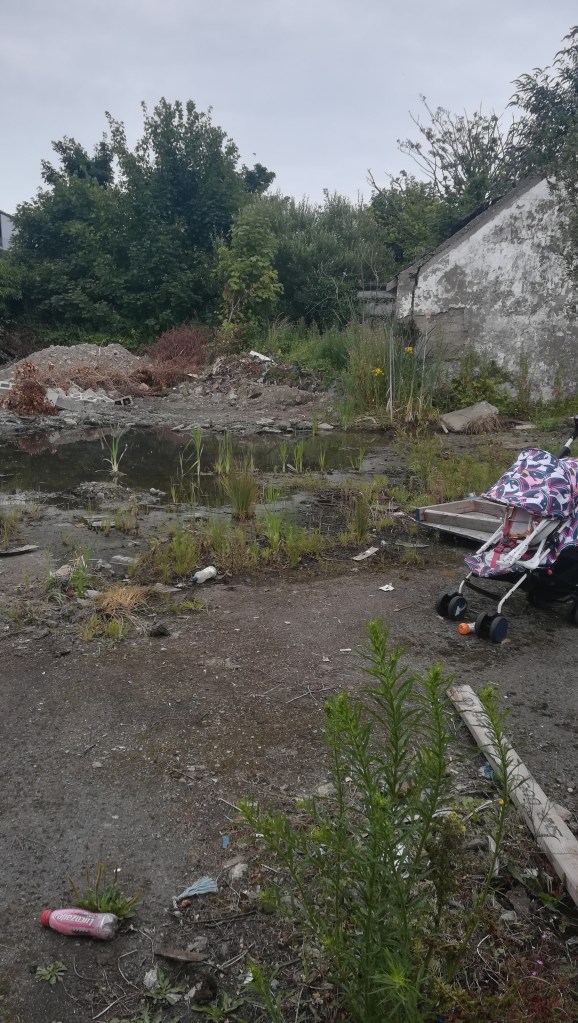
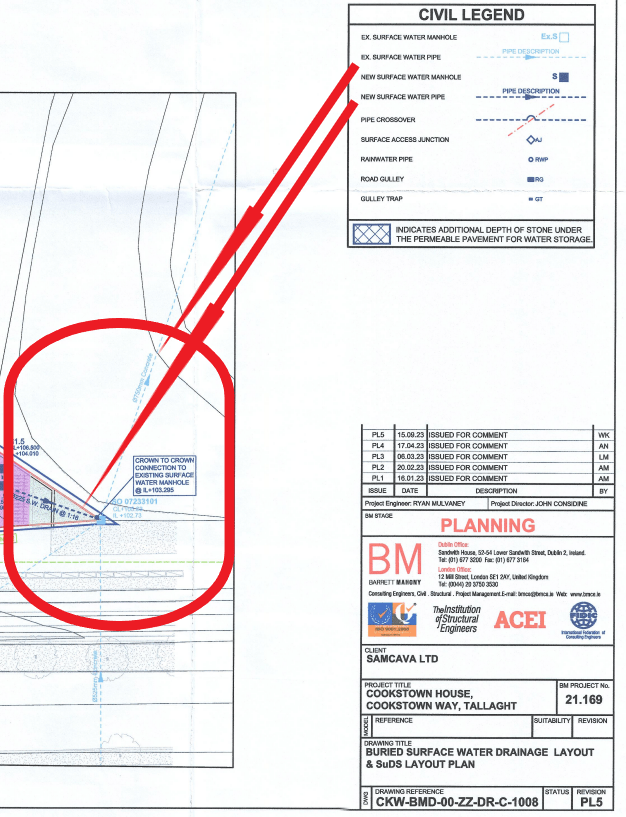
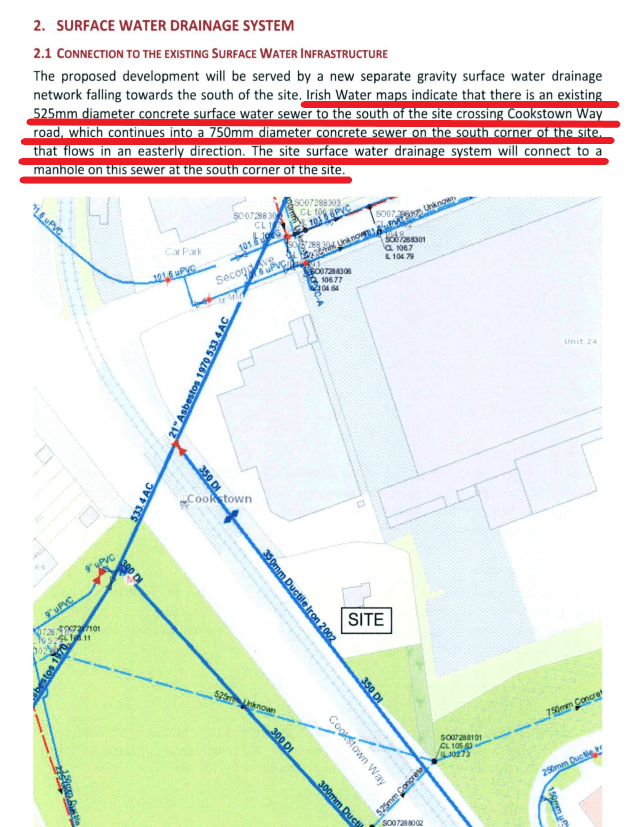
Second, the local authority has for now failed to engage with commitments made in the 2020-2026 Tallaght local area plan to daylight the river Poddle and its source in this upstream part of the catchment whenever possible. This is hardly surprising, however, given that they let developers map the river as a “surface water pipe” at locations where the daylighting is supposed to be discussed (see Cookstown House development example below). The uncovering of the river, in addition to multiple environmental benefits, would make it much easier for us to trace and prevent pollution incidents in a systematic manner.
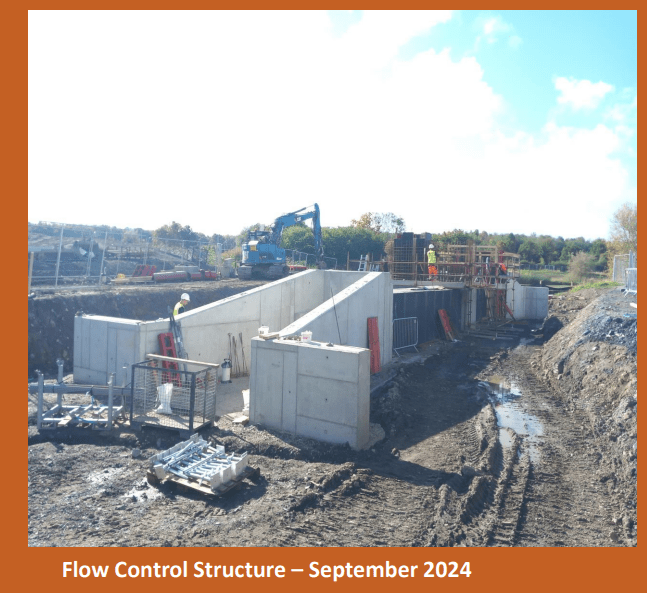
Finally, surprisingly, the heavy engineering conducted in Tymon Park in the last 12 months as part of the river Poddle flood alleviation scheme is never mentioned, as if it had never existed. Admittedly, it could be argued that it is because the works were actually conducted in the other Tymon Park lake which is located downstream of the polluted lake, but still, those heavy works have had not doubt a significant impact on the life, health and habits of the local wildlife and swan population. This is an important element of context which would have been more than relevant in discussions on the current health and wellbeing of the park’s wildlife.
PROBLEM FRAMING: WHY WHAT IS NOT SAID ABOUT IT MATTERS
Critically engaging with problem framing is not just good for its own sake. How you frame a problem in turn determines how you should attempt to solve it (see online articles by Max Liboiron, links below). In the case of the river Poddle pollution problem, it is suggested that identifying pollution sources, addressing misconnections and educating residents will cut it. However, it leaves unaddressed major institutional malpractices and system failures which, if properly engaged with, would have the potential to redefine urban river management in a much more significant way. Emphasizing aspects of a problem which are difficult if not impossible to resolve deflects attention from solutions that are right at hand. Examples of improvements that could be implemented in the short term may include: first, mapping rivers, including culverted rivers, as actual rivers; second, adhering to local development plan commitments. In addition to these short-term improvements, longer-term changes must also be debated as a matter of urgency, including centrally rethinking the strong involvement of private actors in the management of our urban rivers. Until now, based on years of research in the river Poddle catchment, private actors have always opted for profit over the health, safety and wellbeing of the catchment’s residents, human and non-human. There is no reason why they would do otherwise unless we force them to. In sum, without a reframing of the river Poddle pollution problem and its solutions that seriously engages with our many institutional malpractices and system failures, pollution in the river Poddle and its catchment will continue to flourish.
REFERENCES
“Against Awareness, For Scale: Garbage is Infrastructure, Not Behavior”, Max Liboiron
“Solutions to waste and the problem of scalar mismatches”, Max Liboiron
(Laure de Tymowski, August 2025)
Did you know? Walking a river and its catchment are a great way to get to know them! Feet on the ground, you learn a lot about a river, and often much more than by just reading things about it! Most mainstreamed published sources of information about the river Poddle have been produced by state and local government representatives. Engaging with the river in person allows for other narratives, other stories, other river relationships to emerge (the “marginalised and deeply buried”).
The river Poddle flood justice walking tours focus on the flood management practices of the catchment: among other things, you will learn about the dramatic unfolding of past flood events, the main drivers of land management in the catchment, and what has been done and is being done to alleviate flood risk. The overall objective of the walking tours is to give a sense of how various forms of social and environmental inequalities are reproduced and reinforced through our current flood management practices in the catchment. In addition to flood management, other topics will be discussed as urban rivers are much more than just flood hazards! If you would like to arrange a walking tour, please get in touch at riverpoddles@gmail.com. Walking tours can be started at any location in the catchment and can be adapted to any mobility requirements. See you there!

On 11th of July, I was invited to be part of an online open conversation on flood adaptation in the river Poddle catchment kindly organized by Social Rights Ireland. Flood adaption is rarely if never genuinely discussed. A dominant assumption guiding flood adaptation is that engineering is going to make us safe! But there is nothing inherently good about flood alleviation infrastructure. As anything, the infrastructure is embedded in defined social, political, historical contexts. We must urgently create spaces to discuss, scrutinize, challenge our approach to flood adaptation: who decides, who gains, who loses and what kind of futures it promotes/forecloses!
Follow Social Rights Ireland on Facebook (@ConstanceMarkievicz), Twitter (@SocialRightsIRL) & Instagram (@socialrightsireland)!
“Social Rights Ireland is an anti-imperialist, grassroots organisation in Ireland. Our allegiance is to the working class which is why we feel the subject of the Poddle FAS is relevant given that it highlights how democracy works to serve the interests of the ruling class while creating the illusion that the ordinary people of Dublin matter. Our recent activism is focusing on Breaking the chains of Zionism as the genocidal regime could not happen without the might of the Zionist empire. Ireland is not free, nor will be free as long as it is under imperialist subjugation. As James Connolly said: ‘Governments of capitalist societies are but committees of the rich to manage the affairs of the rich.’ We serve neither King, Kaiser nor Zionist.” (Róisín McAleer, SRI)
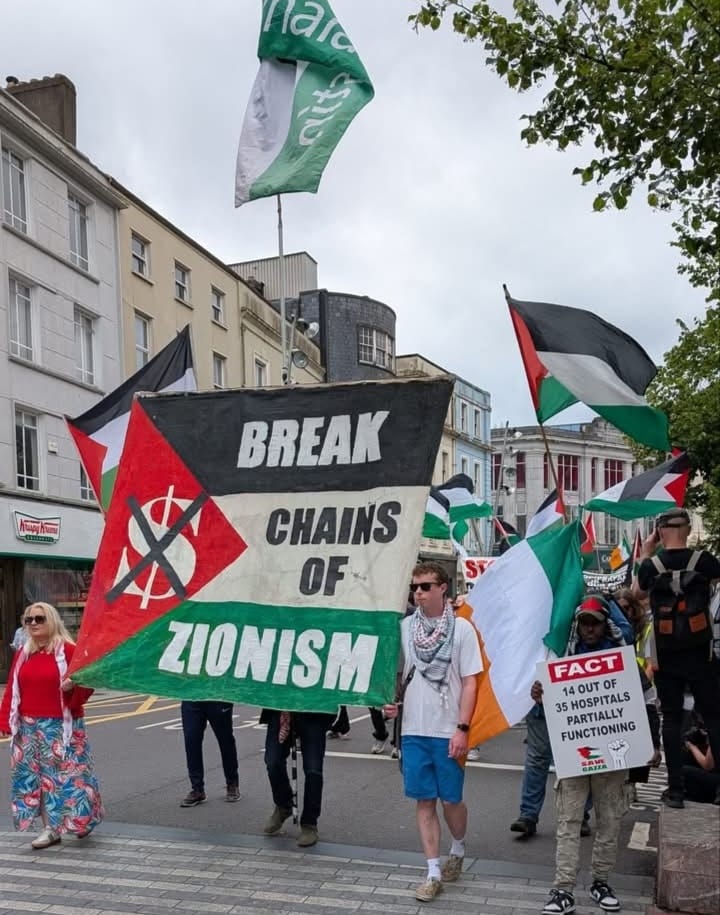
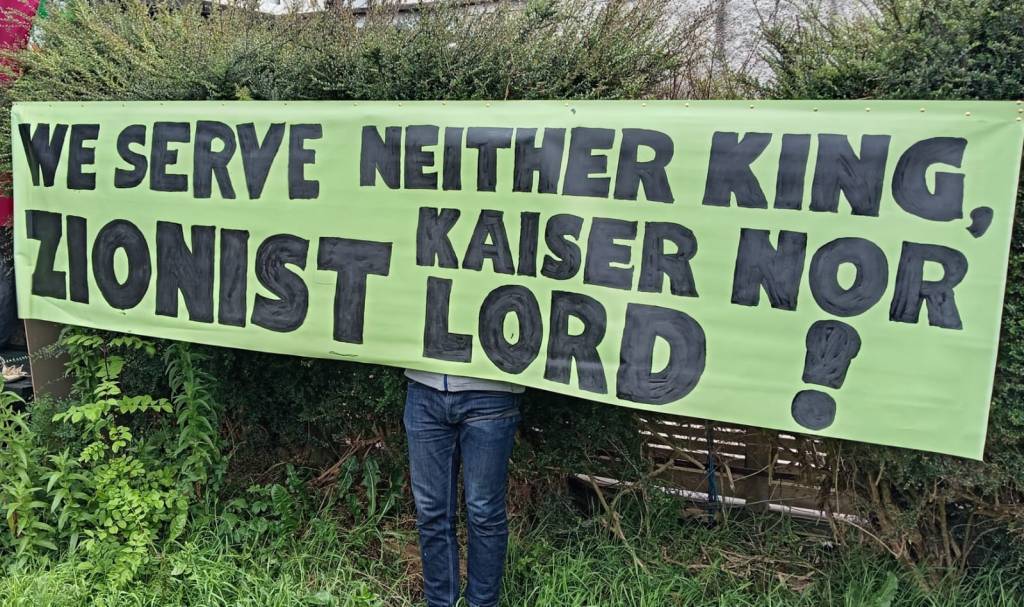
When talking about the river Poddle flood alleviation scheme, those involved in its conception and promotion have outlined its “nature-based solutions focus“. What they don’t say, however, is that the definition of what constitutes a “nature-based solution” remains largely unsettled and open to discussion. Marcus Collier and Mary Bourke, for instance, describe how “nature-based” is used to qualify a wide range of river catchment management practices wich may include “soft” or even “hard” engineering. Their own stance on the concept of “nature-based solution” is that it must include multiple long-term social, environmental, ecological benefits, which in turn asks the question of what/whose benefits should be sought and prioritized.
In short, if you are told about a particular project that it is “nature-based solution” focused, don’t feel intimidated and that it is the end of the conversation ! Far from it, the conversation is just starting ! Ask what is meant by “nature-based solutions” and to be given practical examples of what these solutions may look like. Ask what/whose benefits are pursued through them. Bring in your own perspective, your own experience and your own ideas. In the end, if not democratically debated and scrutinized, “nature-based solutions” will amount to nothing more than greenwashing.
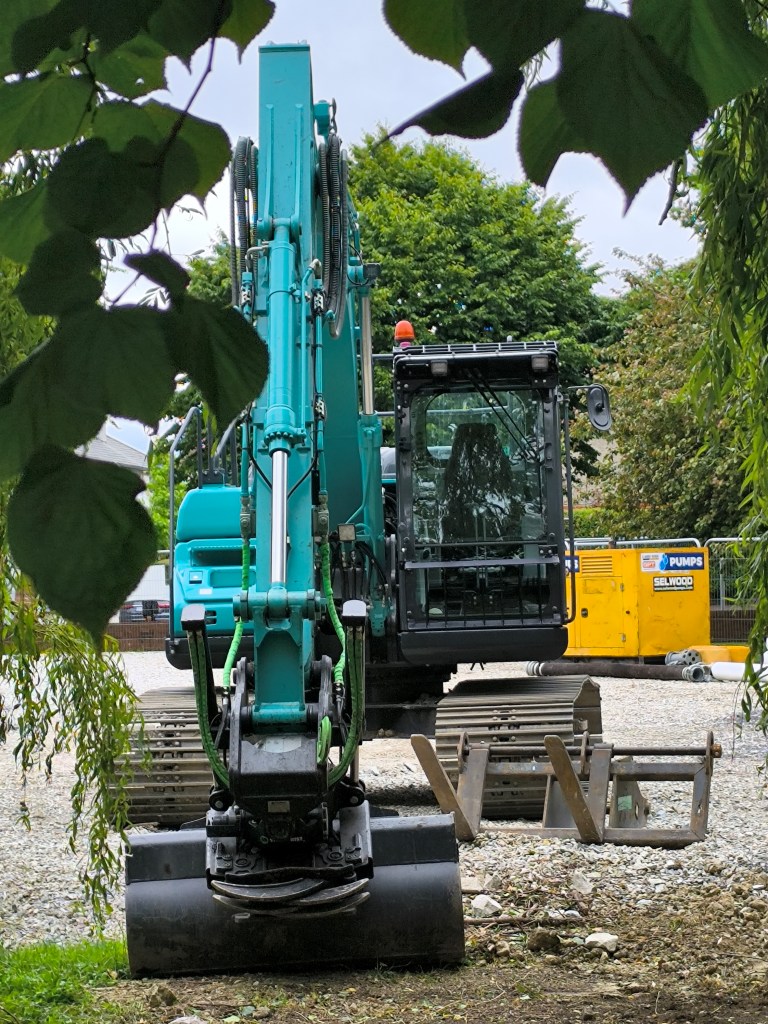
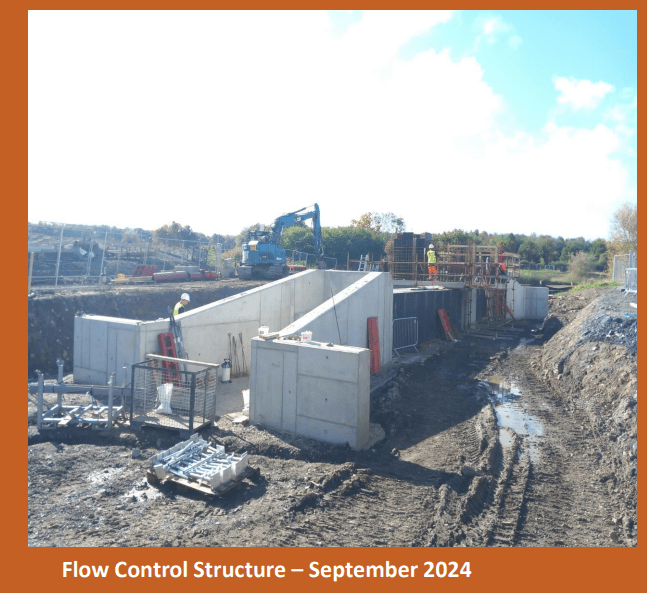
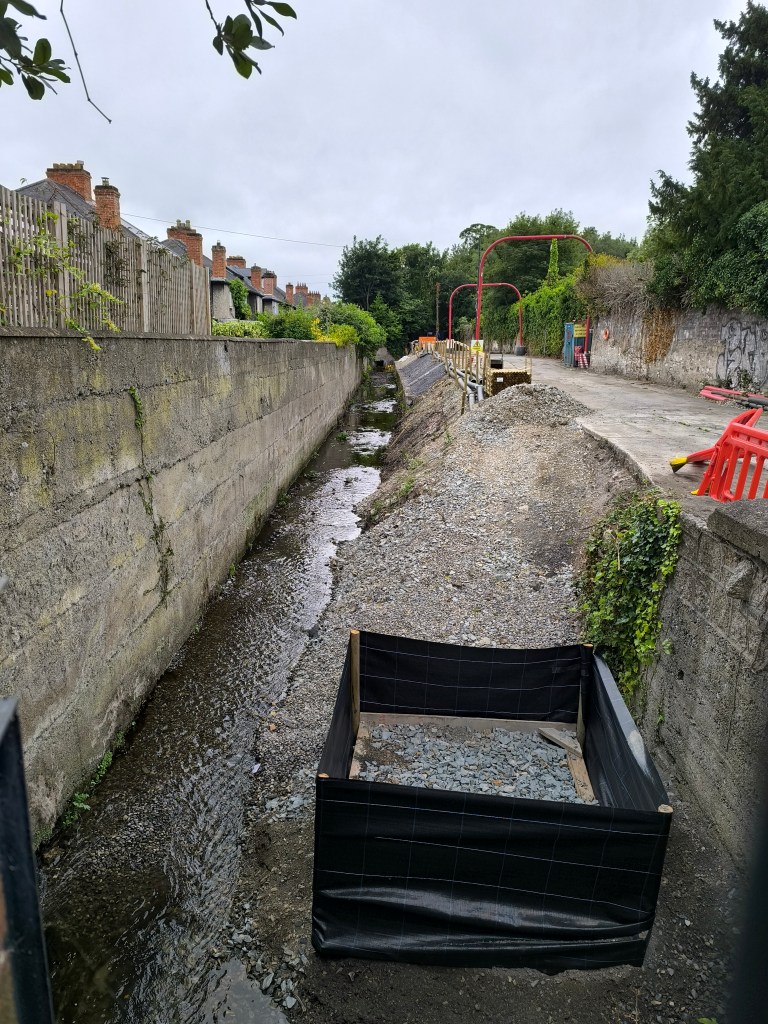
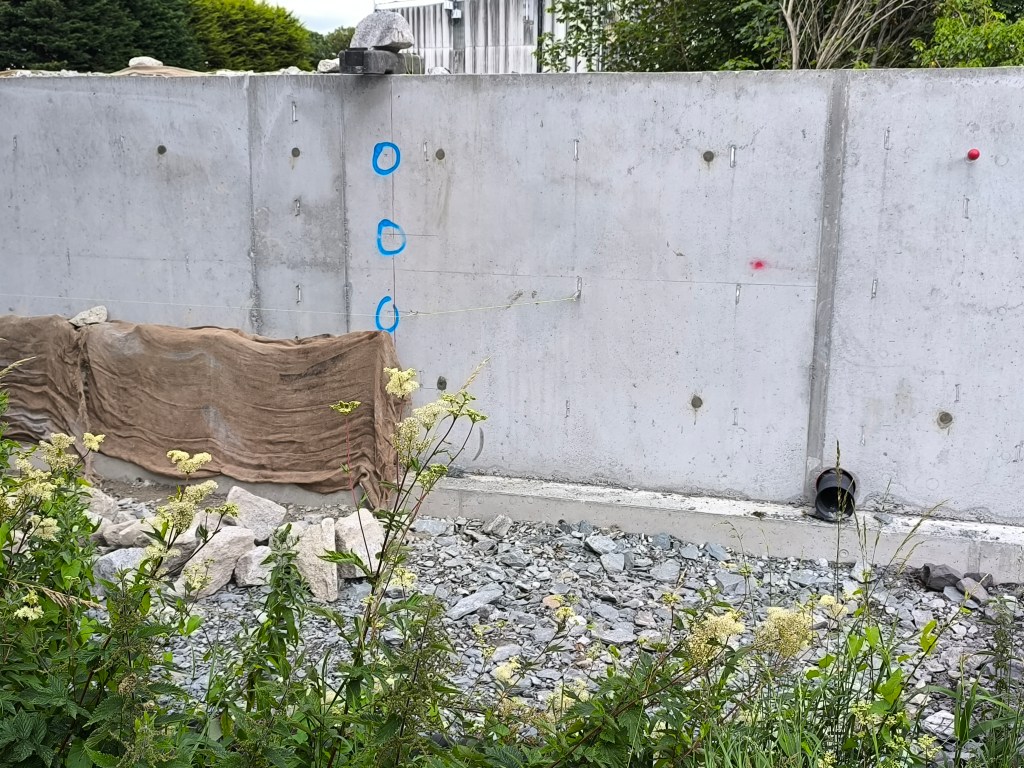
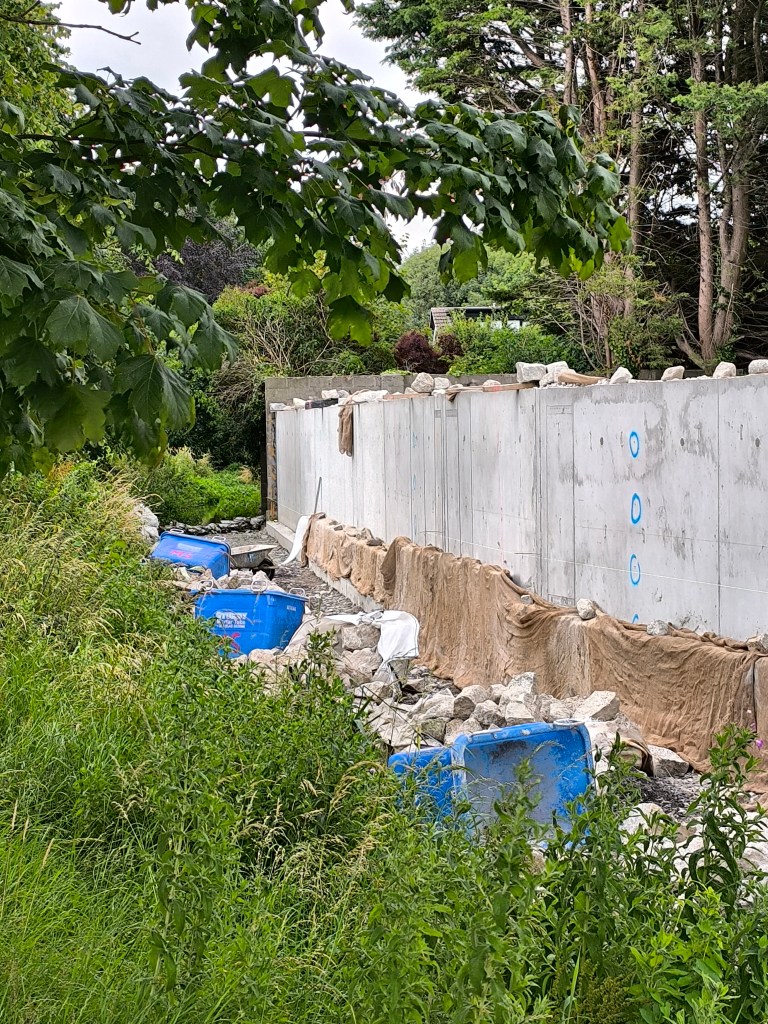
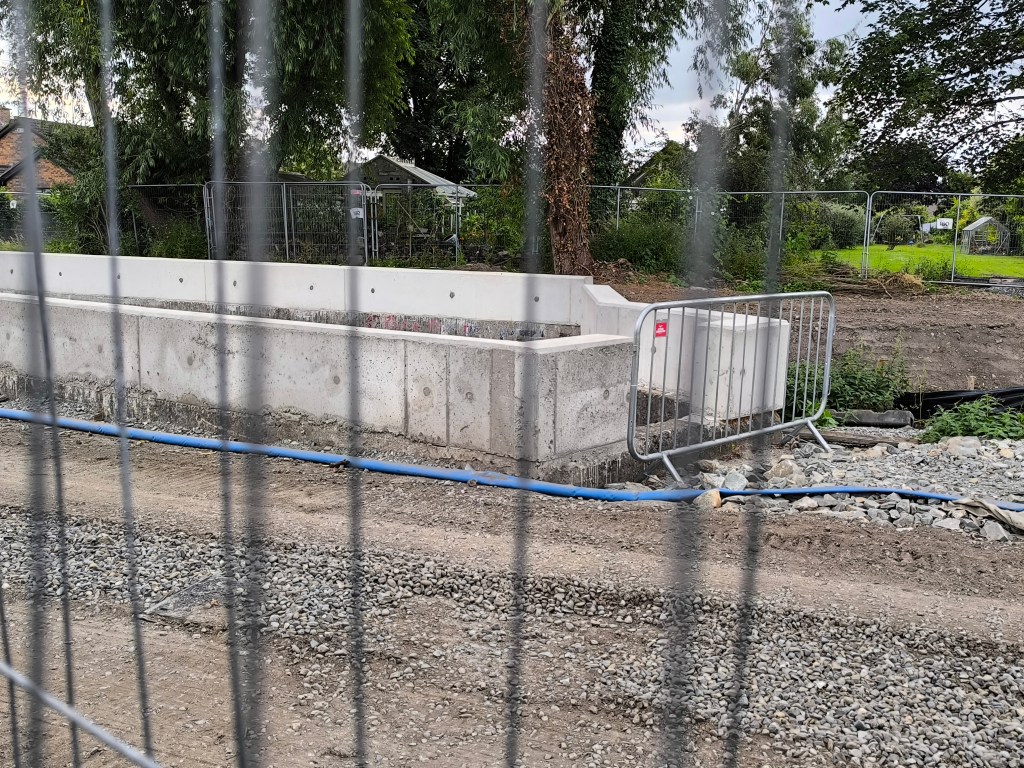

(Laure de Tymowski, July 2025)
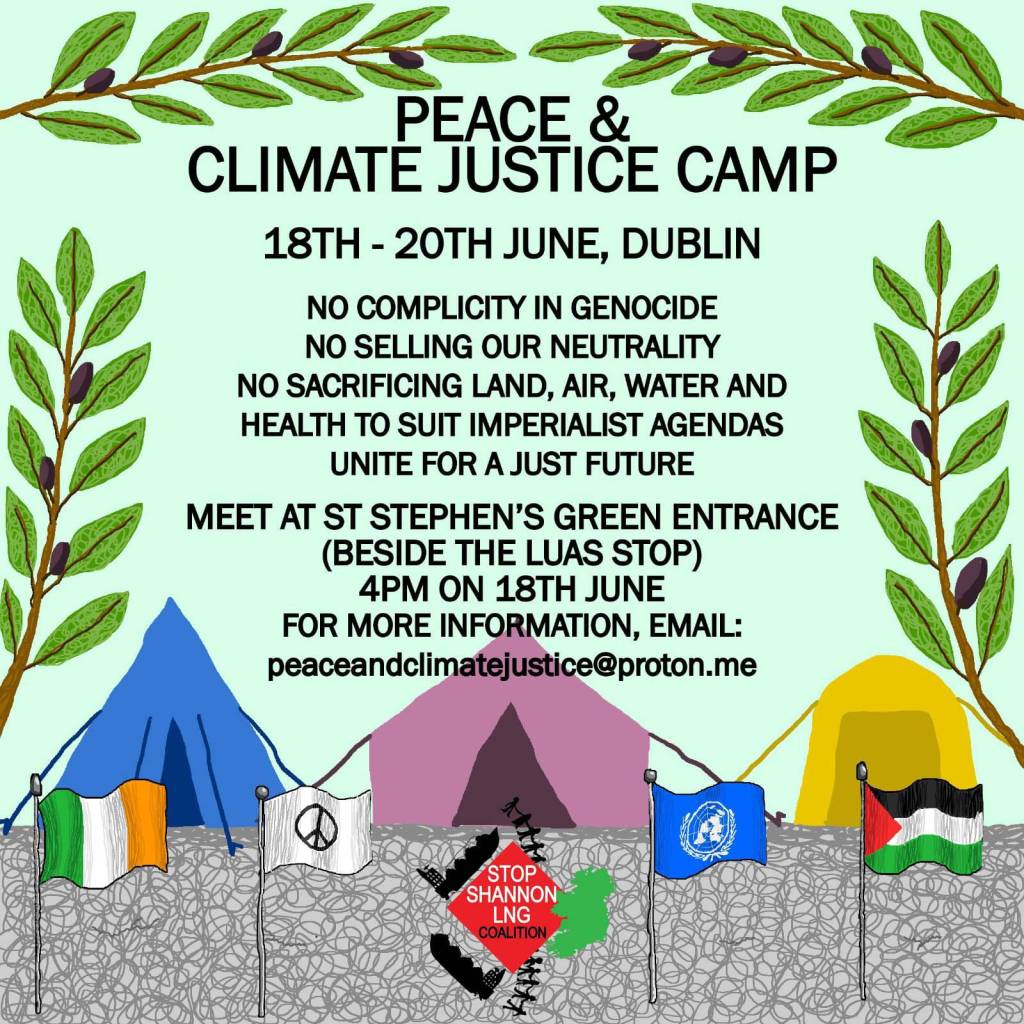
On the 18th of June 2025, I was invited to talk about flood adaptation and land/housing justice at the Peace & Climate Justice Camp 2025. The chosen location for the camp this year was Dublin. The meeting point for participants was one of St Stephen’s Green entrances. The specific set-up location of the camp in Dublin was to be decided during the first hour of the gathering. At 4pm, a group started to form.
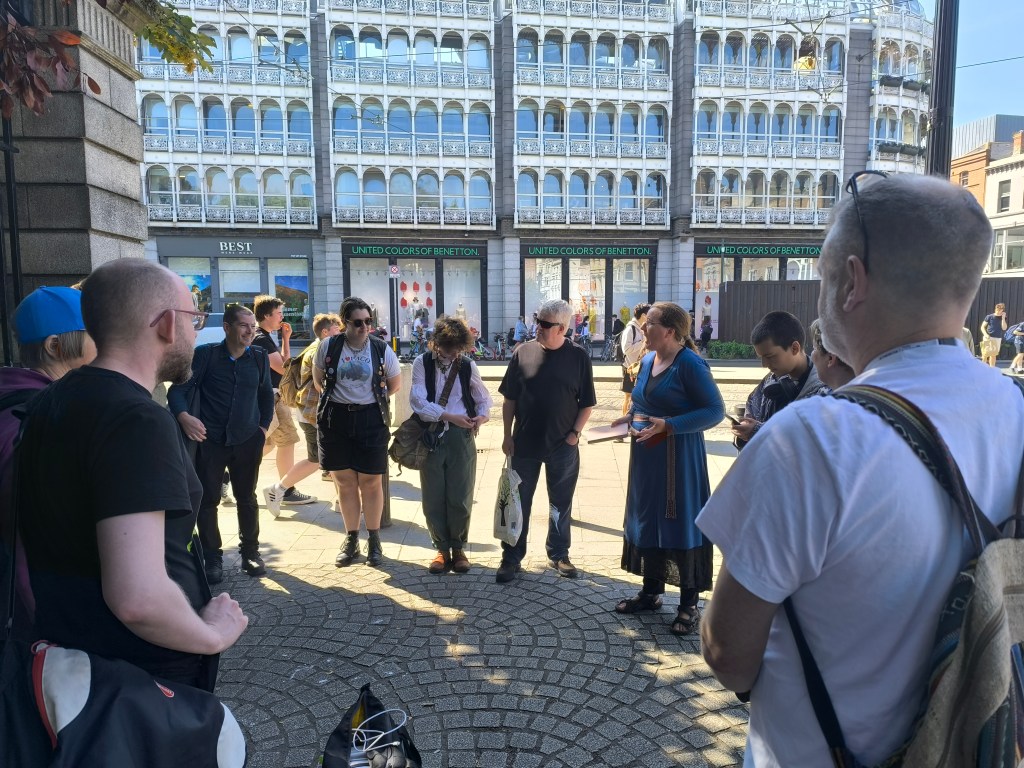
Here we are, a group of incredibly different people who have never met each other before for the most part, gathering in circle to decide together where the camp is to be set up. Discussions are organized so as to be as inclusive as possible. We are told that everyone must be given a voice and that we should all practice and improve our deep listening skills. These initial discussions are so well facilitated: instantly, we feel welcome and part of the group! We feel that our voices matter! To warm us as a collective, a fire prayer is sung.
After a final round of deliberations, we make our way to Leinster House in Kildare Street, the collectively agreed location for the camp set-up!
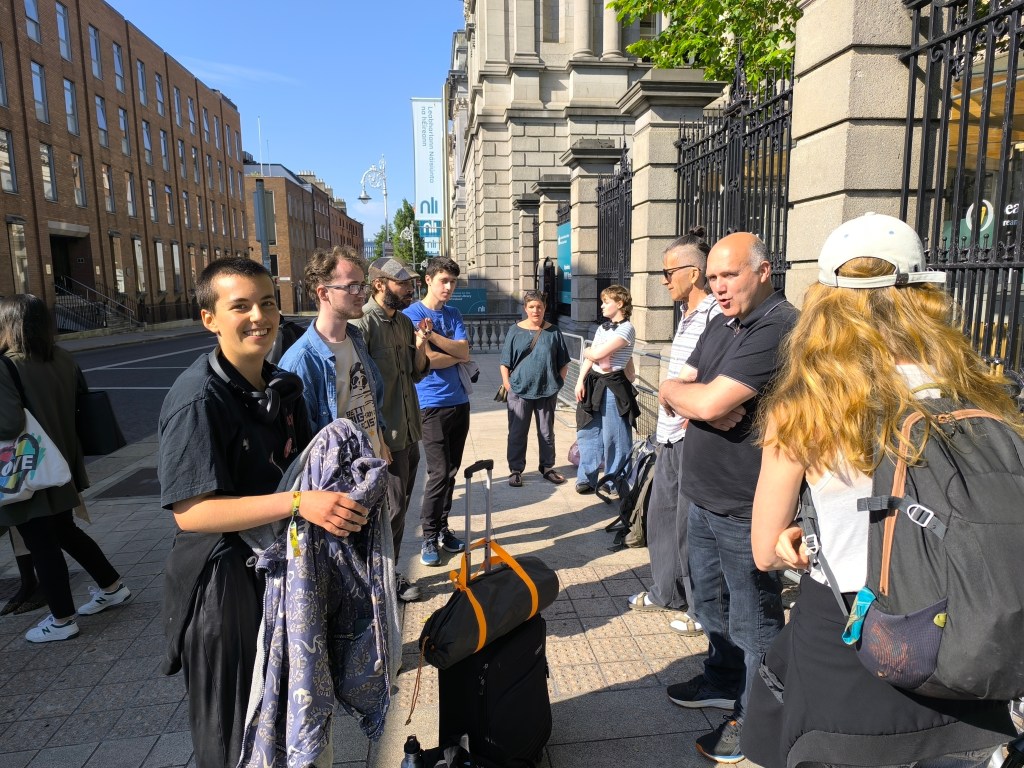

While we are starting to set up the camp, a guard asks us if we are waiting for the bus : )
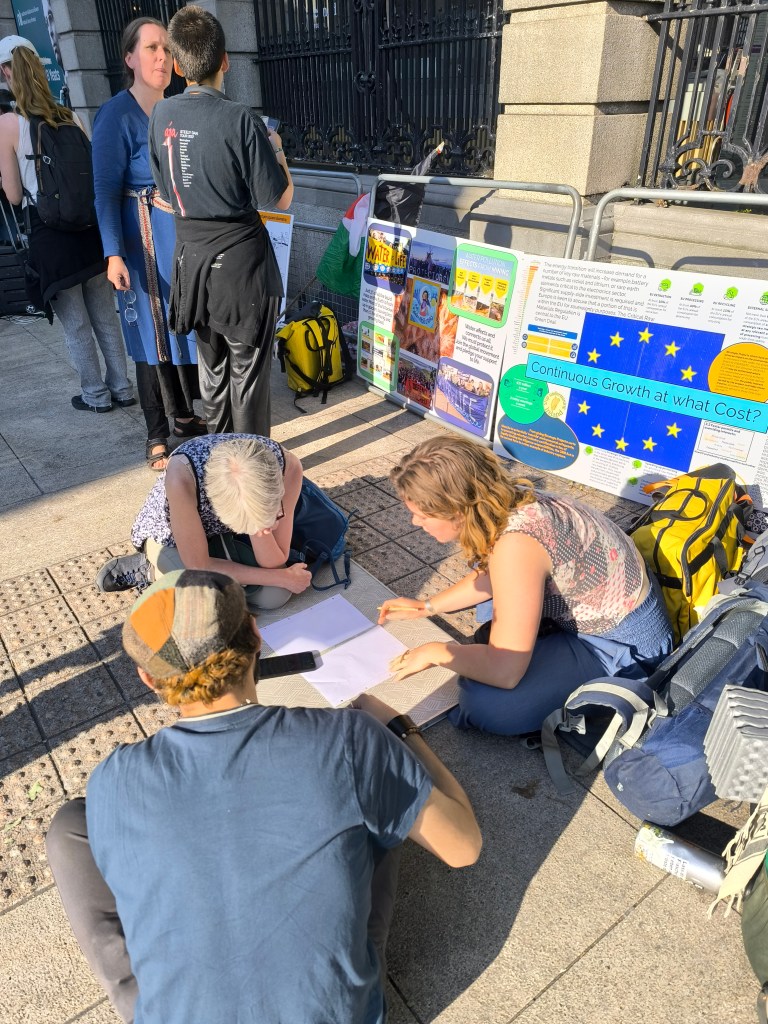
What words are to best represent everyone’s concerns? A small group starts working on finding common words for the camp. A logo is also discussed and, later on, chalked on the ground along with the words “Nature”, “Peace”, “Justice” in both Irish and English.
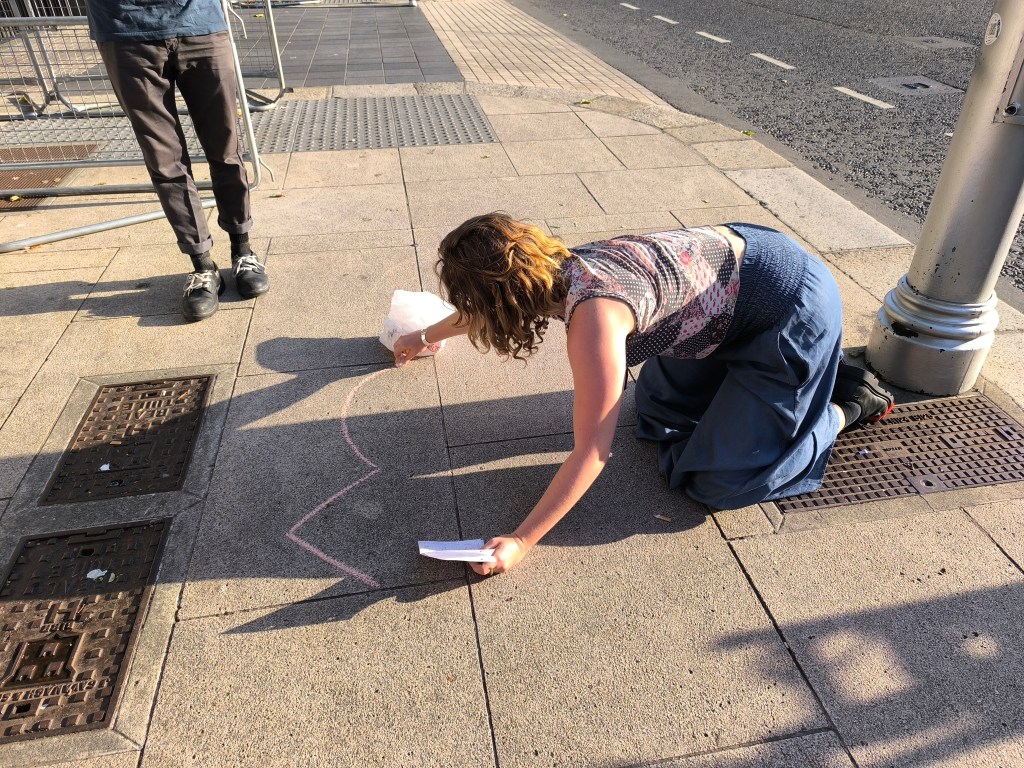
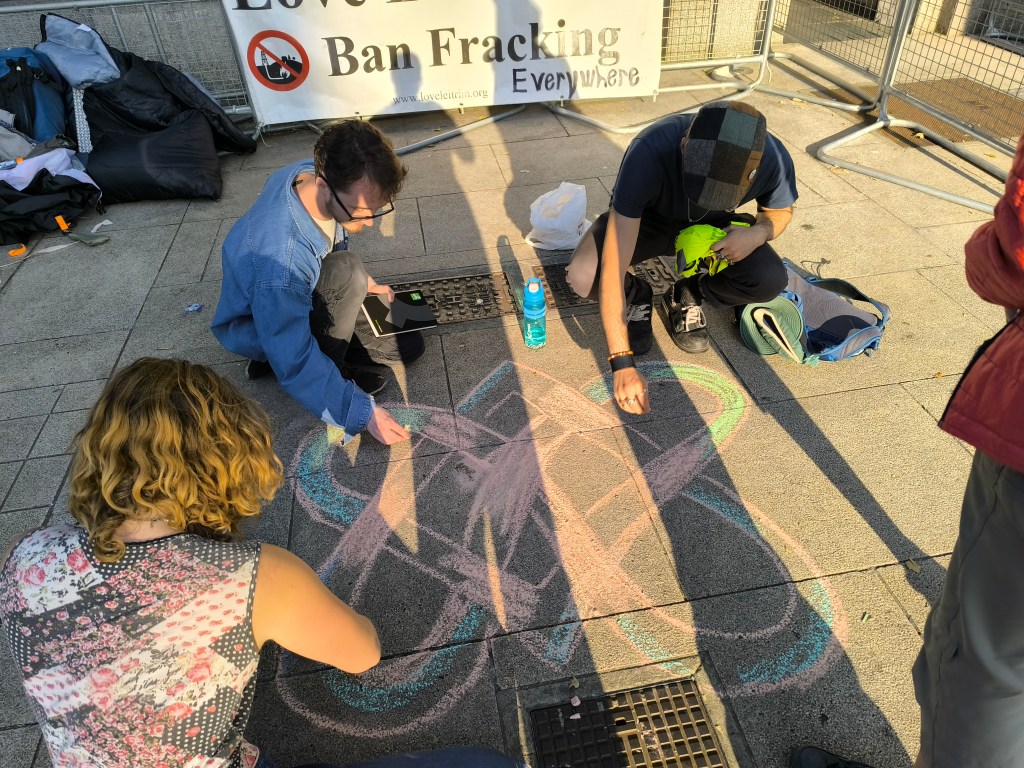

After dinner, I give a brief insight on my research on the politics of flood adaptation in the River Poddle catchment, highlighting how property developers’ greed compromises flood safety, housing security and any alternative futures for the River Poddle. Flood adaptation can only be achieved through land justice!
A central message from the camp is that many of our struggles, if not all, are intimately connected. The traditional urban/rural divide, in particular, must be challenged. Speaking with some of the camp’s organizers, clear links were drawn between the politics of ‘flood adaptation’ conducted in the River Poddle catchment and in north Kerry (see great podcast by Eoghan and Kate below!). A main common thread is, no doubt, land justice. So let’s unite and fight back together!
#StopShannonLNG #SaveOurSperrins #FreePalestine #SaveTheTripleLock #NoToNATO
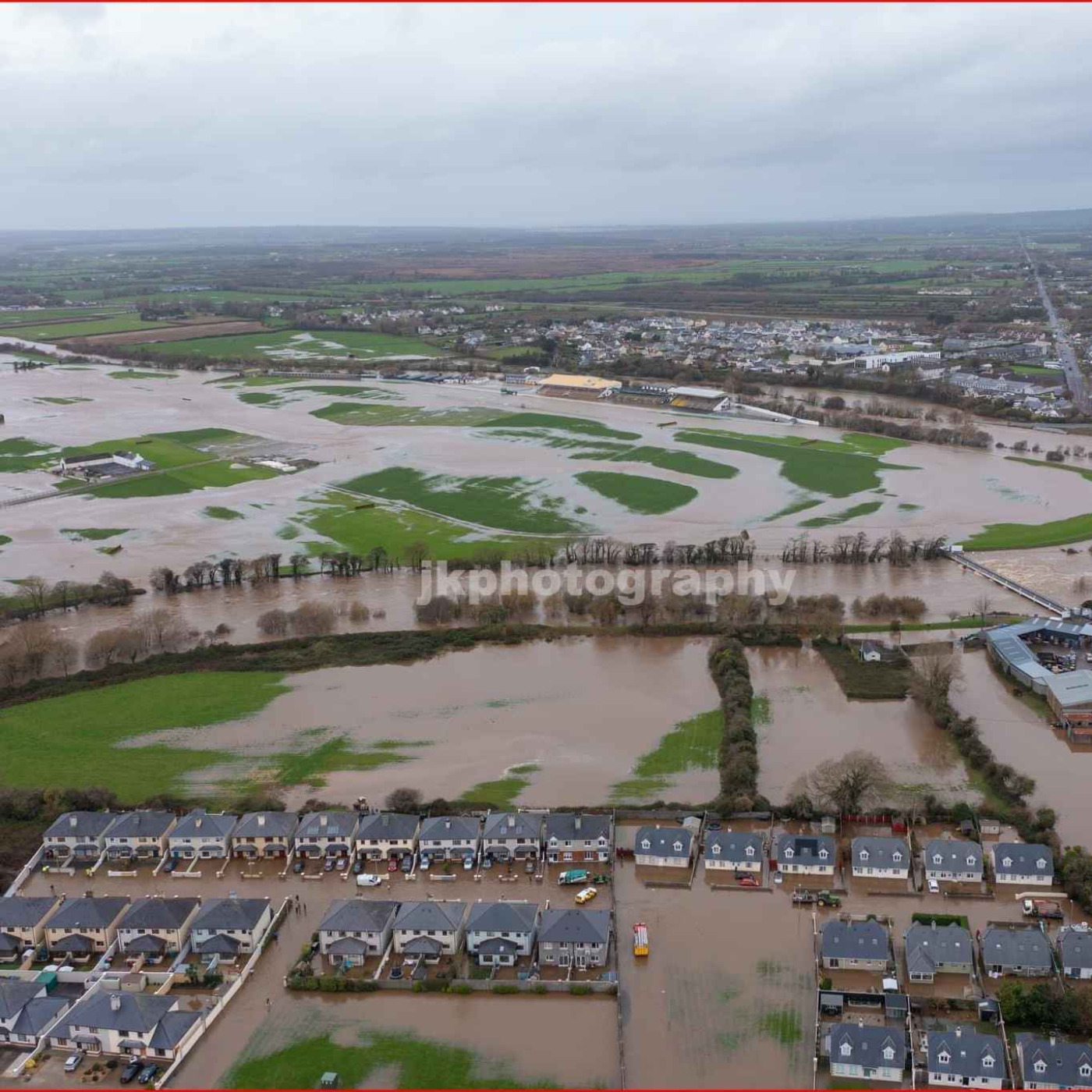
Learn more about Future Generations Kerry at https://futuregenerationskerry.wordpress.com
(Laure de Tymowski, June 2025)
 river-poddles.ie